


This is the year 756.
On a summer day, before dawn, Chang’an was still asleep. Yet, something was happening in the inner circle of the court.
The emperor Xuanzong 玄宗 had notified his close family members, a few loyal ministers, and associates a few days earlier.
In that high summer, hours mattered.
The decision that would shape the course of events over the next seven years, ultimately changing the dynasty’s fate, had come.
But most of the city was kept in the dark.
A thought lingered over the minds of all the people in the city: Will we survive this? Can we hold the rebel attacks?
Before the daylight broke in, before everyone found out, Xuanzong and his associates were already out of the city.1
Within days, Chang’an fell.
Where to go?
By the early 750s, rumors of An Lushan’s 安祿山 (703-757) ambitions had thickened. Li Bai, like others, sensed what was fermenting in the northeast of the country.
But Chang’an was too far. How could he, now as an ordinary person without political influence, persuade those in power to take this seriously?
Some ministers in the court had attempted to convince the emperor that An Lushan had been preparing for war for some time.2
Yet, the emperor Xuanzong disapproved of such accusations against his sworn son. An Lushan was also protected by the emperor’s most favored consort, Yang Guifei.
It was recorded that he had mastered the art of camouflage, playing stupidity, and secured the emperor’s favor. In one conversation, he told Xuanzong that he had no special talent, but was only willing to die for him.3
Like those who had already felt the weight of the political storms, Li Bai was deeply unsettled. He probably had hoped that his suspicion about An Lushan was wrong. Or maybe he hoped that the court was still impregnable, even if against a formidable, imminent rebellion.
In 753, at the invitation of a friend, Li Bai came to Xuancheng 宣城 (in Anhui Province), considering relocating his family there.
Now he was not only dismayed about his unfulfilled political ambitions, but also the precarious fate of the dynasty lying ahead. His heart was shrouded by constant anxiety, fear, and unease:
What left me yesterday
Can be retained no more (棄我去者 昨日之日不可留);
What troubles me today
Is the times for which I feel sore (亂我心者 今日之日多煩憂).4
How could he forsake his ideal? What else could he do? The anguish of the heart forces the poet into a state of unbounded spiritual outbursts:
Cut running water with a sword, ’twill faster grow (抽刀斷水水更流);
Drink wine to drown your sorrow, it will heavier grow (舉杯消愁愁更愁).
If we despair of human affairs (人生在世不稱意),
Let us roam in a boat with loosened hairs (明朝散髮弄扁舟)!
The long war
In 755, the An Lushan rebellion erupted.
At the beginning, the emperor Xuanzong and some ministers greatly underestimated An Lushan, assuming the rebellion could be easily suppressed.
An Lushan rose to power through military achievements. Over the years, he also built a strong military base in Fanyang 范陽 (a district covering part of today’s Beijing), with the surrounding regions under his jurisdiction.
Before the outbreak of the war, he had already amassed an enormous army.
From Fanyang to Luoyang 洛陽, a critical city for the Tang defense, lies a roughly 800-kilometer distance. An Lushan’s army marched to victory in roughly a month.
The following year, An Lushan declared himself emperor of the Yan 燕 in Luoyang, with vast territories in the eastern part of the country under his rule.
A variety of factors led to the initial setbacks of the royalist defense. First, Xuanzong’s misjudgment of the situation and problematic military decisions. And there was the mishandling of the defense by some generals.
After Tongguan 潼關, the crucial city that connects Chang’an to the east, fell into the hands of the rebel forces, the capital was laid bare, basically defenseless.
So, on that early morning of 756, when the court ministers, including most of the royal family, found out that the emperor had already fled the capital, the war was destined to be dragged into deep waters.
Li Bai witnessed the fall of ancient cities and the dispersed people fleeing:
Throughout the realm’s heartland, tigers and jackals roam,
fierce flames devour the ancestral shrines (中原走豺虎 烈火焚宗廟).
Venus crosses the sky in daylight
the failing sun veils what’s left of its light (太白晝經天 頹陽掩餘照)
The royal cities were destroyed, swept away,
the roads of the world all turned steep (王城皆盪覆 世路成奔峭).
All under heaven looks toward Chang’an
brows knit, few can force a smile (四海望長安 顰眉寡西笑)5
Temples in flames, the capital overturned, and ordinary roads became unrecognizable. It was not just city collapses, but also the fall of an era.
Despite the eventual victory of the royalist side, Chang’an was never the same.
After the outbreak of the war, Li Bai brought his family farther south, like many ordinary families. No one could be certain that the rebel armies would treat the people of the Tang dynasty decently.
But even during such times of chaos, Li Bai was also hoping to contribute, to do whatever he could to save the realm. Writing to a friend, he reaffirmed his will:
I stroke my long sword with one lift of my brow
…
I take off my cap and laugh toward you.
I drink your wine and sing for you
Zhang Liang has not yet gone off to follow Chi Songzi
the yellow stone at the bridge understands my heart.6
Inside the storms
In the chaos, Li Bai once again drifted toward politics—this time as a staff member of Prince Lin 永王 (Li Lin 李璘).
Whether out of hope, misjudgment of the shifting political circumstances, or being forced, he joined the camp of Prince Lin.7
Li Bai may have assumed that he was still fighting alongside the royalist forces, openly expressing his wish:
The drifting clouds are to be cut in one sweep
I swear to cleanse the rebel forces at the You 幽 and Yan 燕
I wish to sit with the gentlemen here in this hall
and calmly talk about the “Golden Casket” chapters.
With one heart we bear the court’s favor,
we would not spare our humble lives.
All we hope is that the war-star will be extinguished,
and when the work is finished, follow the steps of Lu Lian.8
Unfortunately, in a war that lasted about seven years, politics was often more complex and consequential than temporary battlefield gains and losses.
While the emperor Xuanzong was on the run to Chengdu, one of his sons, Li Heng 李亨, declared himself the new emperor, known as Suzong 肅宗.
Before long, the internal conflict between Prince Lin and the new court ended in disaster: the prince was defeated, and Li Bai was punished for having “followed the wrong side.”
He was imprisoned for a few months at Xunyang 潯陽 (a district in today’s Jiujiang, Jiangxi province) and then sentenced to exile.9
Final years
In 758, Li Bai started his journey of exile from Xunyang to Yelang 夜郎 (in today’s Guizhou province). This year, he turned 58.
On his way there, Li Bai often thought of his wife, who was far away but actively seeking ways to save him. He wrote to her:
I grieve my life apart as Yelang is beyond the edge of heaven
in a tower under the bright moon, news grows scarce.
The northern geese return with spring, soon traces gone,
yet no letter from home comes south to me.10
The roads and mountains stalled family letters. Li Bai probably envied the birds that could fly wherever they wished.
In 759, he was released due to the court amnesty.
Near the end of his life, Li Bai was still preparing to join the forces of Commander Li Guangbi 李光弼 to fight the remaining rebels. Eventually, illness stopped him.
In 762, Li Bai died in Dangtu 當塗 (today’s Dangtu county, Anhui Province). His tomb is still preserved there.
Ending thoughts
As a Taoist at heart, a romantic poet, Li Bai was well aware that life was a mysterious yet natural course.
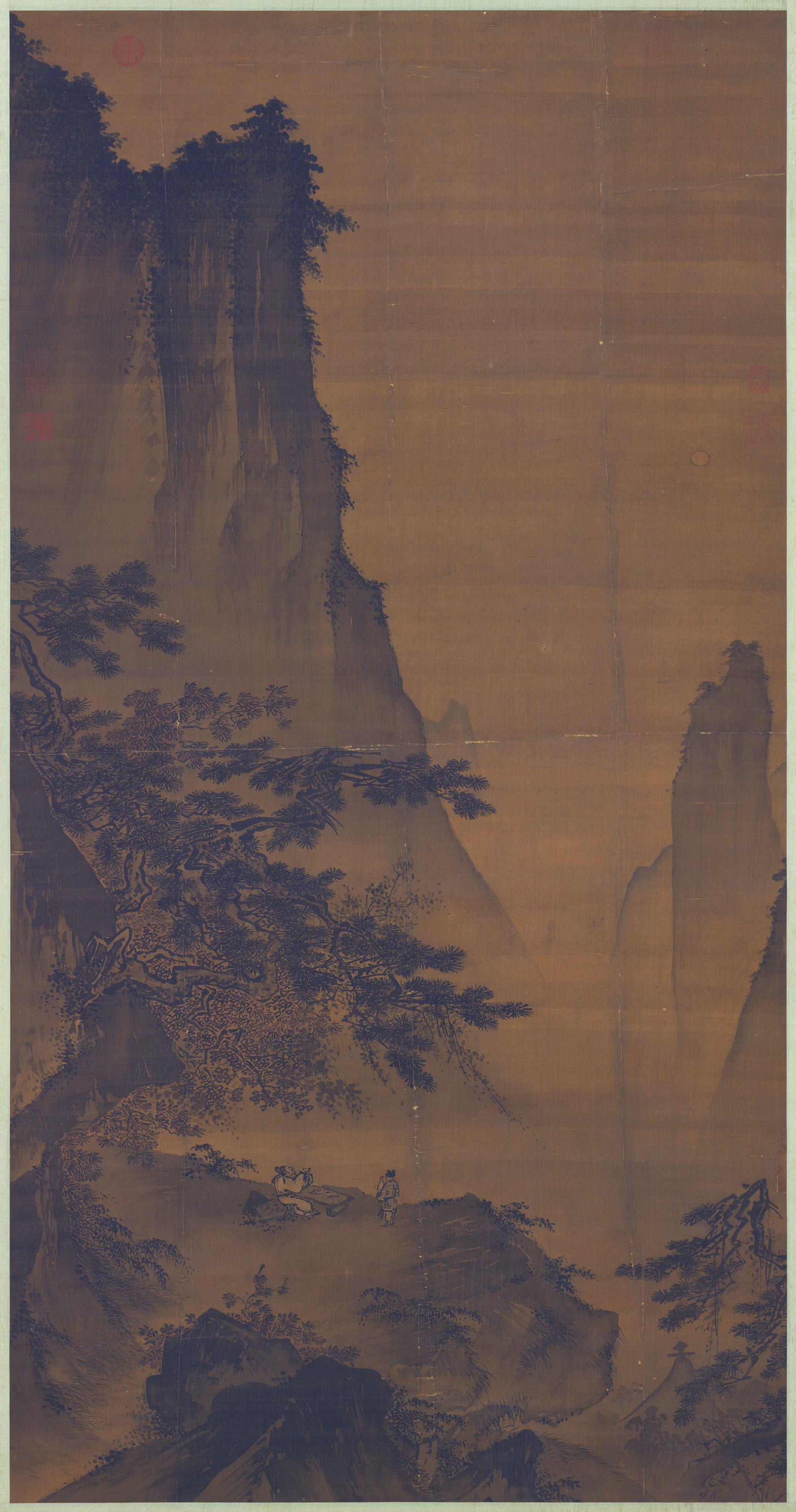
The vicissitudes of fortune, dynastic or personal, are often beyond our control and imagination.
The myriad social and personal factors at play with one another could corner us into an unbearable, clueless situation. We could still charge forward, with a relentless spirit and will. Yet, we sometimes cannot help but sense that the wheel of trends, regardless of our preferences and wishes, can be set on an irreversible trajectory.
So we are often at a loss, at times awestruck, gazing at the turning of personal fate as it is swept along by the flow of time, tossed around by something unidentifiable, something higher than our own will, often manifesting itself as a wonder, a surprise, a crisis.
Perhaps, in his times of exile, in those quiet moments, with wine, with moonlight, Li Bai contemplated the fate of the Tang dynasty, the misfortune of the individuals, all enmeshed in the mystery of the currents and cross-currents of life:
Grass does not thank spring for its wind (草不謝榮於春風)
Trees don’t blame autumn for their leaves (木不怨落於秋天).
Who wields the whip that urges the seasons (誰揮鞭策驅四運)?
All things rise and fall by themselves (萬物興歇皆自然).11
He was not like the professional politicians working at a stable post. His life was undeniably characterized by wandering, but deeply pulled by the aspirations for achievement. It was his way of making sense of the ever-evolving social and political changes, and his own way of being during this temporary stay.
Li Bai wrote more than one thousand poems, which is only based on the surviving records. We do not know how many, perhaps even more, diverse forms of writing have been lost due to the years of war and later efforts of preservation.
When I was young, I liked the poem “What left me yesterday” from Li Bai’s works the most. It felt cathartic and refreshing. Yet I did not understand, not have tasted the bitterness, the helplessness, underlying it. I was naive and inexperienced.
Now, when I think of Li Bai, after lifting all those romantic layers of imagination, I keep to this poem to the moon and wine:
When did the moon come to the blue sky?
青天有月來幾時
I pause my cup and ask.
我今停杯一問之
…
People of today don't see the moon of ancient times
今人不見古時月
yet the moon of today once shone on the people of old.
今月曾經照古人
Ancients and moderns pass like running water
古人今人若流水
together we gaze at the bright moon, always the same.
共看明月皆如此
Only this I wish: singing with wine before me
唯願當歌對酒時
may moonlight always shine into the golden goblet.
月光常照金樽里
To nature and the moon, we are only temporary travelers, guests.
This is not to negate our existence. With the short life we have, it is still within our reach to preserve what is good, precious, and imperishable in this human life.
Li Bai would have hoped, like all of us, that generations after him would live in a world without wars and conquests, with peace and harmony cherished, not torn by scheming and machinations.
It is a world in which it is safe for simple joys. With wine and moonlight, with family and friends, with the things we care about. And that is enough.
Previous posts on Li Bai:


Sima Guang et al. Zizhi tongjian 資治通鑑 (Comprehensive Mirror in Aid of Governance), volume 218, “Tang ji” 唐紀 34, Wikisource, accessed February 10, 2026. https://zh.wikisource.org/zh-hant/資治通鑑/卷218
Zizhi tongjian, volume 217, “Tang ji” 唐紀 33, Wikisource, accessed February 10, 2026. https://zh.wikisource.org/zh-hant/資治通鑑/卷217
Ouyang Xiu 歐陽修 and Song Qi 宋祁 et al., “Xin Tang shu 新唐書, volume 225, part 1: Liezhuan 150.1, ‘Nichen (Rebels): An Lushan,’” Chinese Wikisource, accessed February 10, 2026, https://zh.wikisource.org/wiki/新唐書/卷225上.
Li Bai, Selected Poems of Li Bai, trans. Xu Yuanchong (Changsha: Hunan People’s Publishing House, 2007), 179.
Qu Tuiyuan 瞿蛻園 and Zhu Jincheng 朱金城, eds., “After the Turmoil: Leaving for Shanzhong — For Cui Xuancheng 經亂後將避地剡中留贈崔宣城” in Li Bai ji jiaozhu 李白集校注 (A Critical Edition of Li Bai’s Collected Works with Commentaries), vol. 1 (Shanghai: Shanghai guji chubanshe, 1980), 811.
Li Bai ji jiaozhu, “Ballad of the Fufeng Gallants 扶風豪士歌,” 494. The Chinese lines cited read: 撫長劍 一揚眉 清水白石何離離 脫吾帽 向君笑 飲君酒 為君吟 張良未逐赤松去 橋邊黃石知我心
“Yellow stone” in this poem refers to a Taoist master who gifted Zhang Liang a book on military affairs and statecraft.
Notes on Zhang Liang can be found in the footnote of this post. Information about Chi Songzi 赤松子, another legendary Taoist, can be found here.
Zhou Xunchu, A Critical Biography of Li Bai (Nanjing: Nanjing University Press, 2005), 139.
Arthur Waley, The Poetry and Career of Li Po (London: George Allen & Unwin, 1969) 79-80.
Li Bai ji jiaozhu, “在水軍宴贈幕府諸侍御,” 712. The Chinese lines cited read: 浮雲在一決 誓欲清幽燕 願與四座公 靜談金匱篇 齊心戴朝恩 不惜微驅捐 所冀旄頭滅 功成追魯連
Lu Lian, known as Lu Zhonglian 魯仲連, is Li Bai’s hero. A short note on him can be found here.
Li Bai ji jiaozhu, 1768-1771.
Li Bai ji jiaozhu, “On the Night Drifting South to Yelang, Sent Home (南流夜郎寄內),” 1497. The Chinese lines read: 夜郎天外怨離居 明月樓中音信疏 北雁春歸看欲盡 南來不得豫章書
Li Bai ji jiaozhu, “Sunrise and sunset (日出入行),” 267.
Fascinating.
Sadly in my supposed Humanities secondary school classes at Eastern Civ they skipped . All of India, China, Southeast Asia oh and the Middle East and Africa! We are atupid about other peoples here in the good ‘ol’ USA . Tragic for us and the world.
Yes, that is enough. Thank you.