

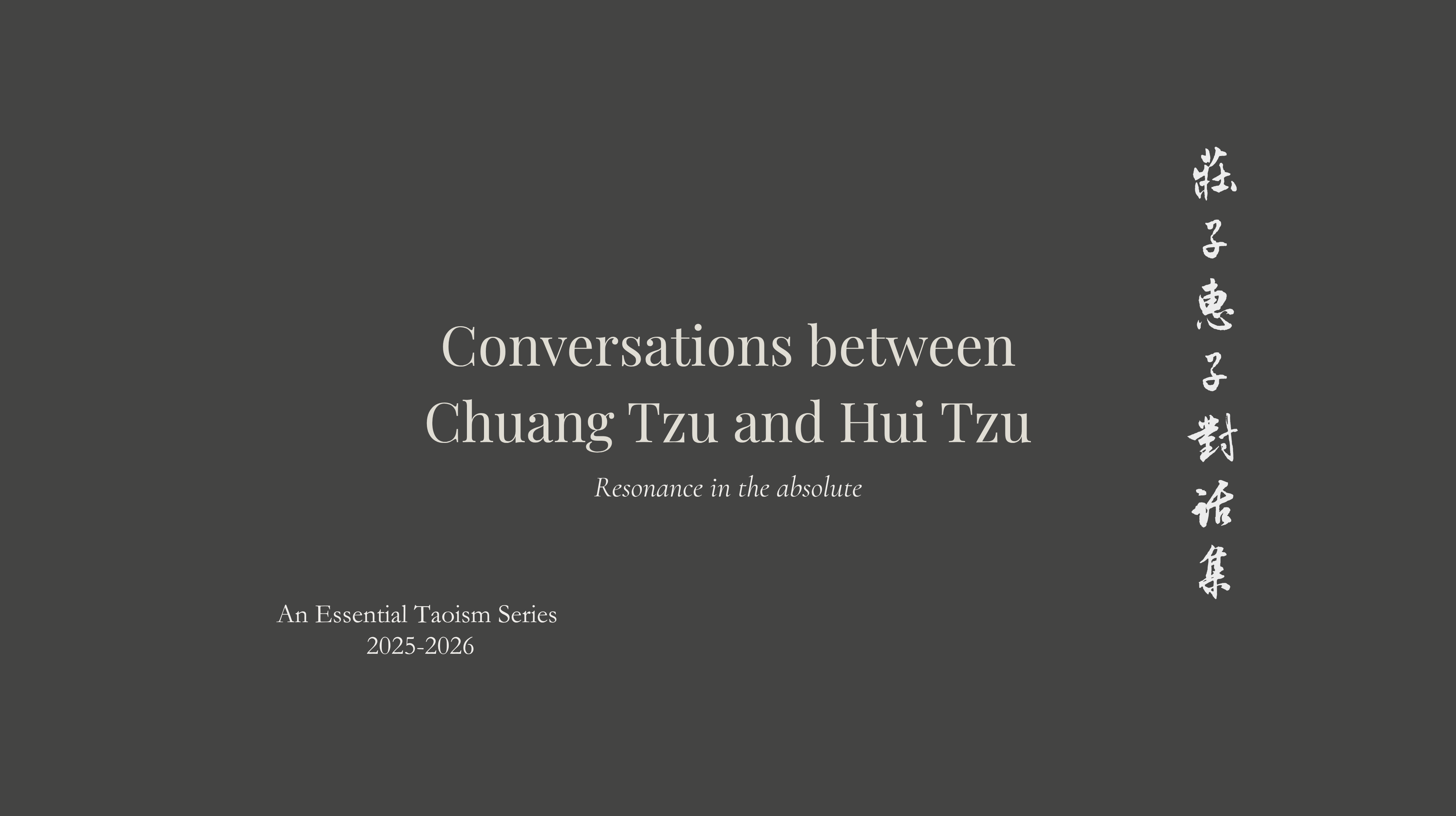
SERIES: Conversations between Chuang Tzu and Hui Tzu
Dialogue and friendship between two brilliant minds

Inside the Dialogue that Shaped Chuang Tzu’s Way of Seeing the World
From spiritual freedom to the philosophy of non-distinction, from living naturally to facing impermanence and life and death, this series introduces his core ideas through eight guided readings.
Do you know why the book, Chuang Tzu 莊子,1 was treasured in traditional China?
Not as a book of ideas, but as a source book for inner inspiration and self-mastery — the kind that transforms your mind and spirit as you go through the parables, conversations, and insights in it, as you feel its subtle influence on your life.
The ancients returned to it century after century.
For the literary and philosophical mind, for the contemplative and artistic individuals, the book was read as “spiritual food.” They discovered, throughout its pages, the profound beauty of human thought, imagination, and poetry, the fountainhead of creativity and inspiration.
For the artisans, dedicated practitioners keen to excel in their craft and live a life in accordance with their nature and talent, the book was a lifelong guide, a silent companion.
And for the ordinary person struggling in the midst of living, while constantly wrestling with feelings of isolation and anxiety in the face of life’s inevitable challenges—loss, failure, uncertainty, and conformity pressures —Chuang Tzu was a friend, a voice of wisdom, consolation, and hope.
They knew it had a strange, invisible, and quiet power: it helps one develop the ability to stop injuring oneself from within, despite being spiritually exhausted, and, most importantly, to remain inwardly lucid, staying on the path that is authentic and natural to oneself.
It is a book that inspires different responses and sentiments in your life, in the changing shapes of reality.
And one also finds those deeper, hidden, sometimes even mysterious undertones beneath Chuang Tzu’s masterful use of language.
His words act as the bridge to his soul, reaching your soul, across time and space.
This series opens the book through dialogue. This is where Chuang Tzu’s thought is most vibrant: in clashes, jokes, parables, and stories.
Why these dialogues
The Chuang Tzu was written without a particular group of audience in mind.
Its substance and style — mostly composed of allegories, conversations, and scattered philosophical insights in essays — reveal that it is a book for all of us, the ancients and the modern individual.
Chuang Tzu does not offer a system to believe in. He offers a different way of seeing, a way of liberation.
And nowhere is that way of seeing more alive than in his conversations with Hui Tzu 惠子 (c. 370-310 BC): a brilliant rhetorician, a politician, and the friend who constantly challenged him.
Yet still, most conversations get lost in noise, misunderstanding, enforced silence, and oblivion.
But the ones that stand the test of time helped preserve the human spirit, the innermost wish of being truly understood.
These conversations of Chuang Tzu revolve around different themes that transcend their particular time.
A defining moment in reading them is encountering the note that resonates, offering us a window into the fundamental frequency where their reflections on value, friendship, love, life, death, and everyday intellectual sparring can become a spiritual sanctuary.
What you’ll encounter:
Chuang Tzu lived in one of the most turbulent times in the ancient world, the Warring States period (475-221 BC). So his writings, to some extent, reflect the disorder of the political and social atmosphere, the trepidation and worries of the many, and the agitations and aspirations of the thinkers and practitioners of the time (see the other series, Glimpses into Chuang Tzu’s World).
Yet in a world that was predominantly obsessed with utility and being useful, Chuang Tzu offered something contrarian: the big use of uselessness.
In a cultural context that prioritized hierarchy, control, convention, and worldly pursuits, Chuang Tzu wrote from the standpoint of the individual: awaken your soul within, cherish your natural talent, preserve your spirit, and give your heart the freedom to roam in the infinite, boundless realm.
Chuang Tzu’s writings are not abstract doctrine, but suggestive and provocative, and visibly existing as living moves of thought. They are never rigid or arbitrary, aligned with the Taoist spirit of letting things freely be.
In the face of the “muddy waters” of this world, his teachings, surprisingly applicable, can function as a guide to help you navigate the currents of chaos and uncertainty without losing your authentic core.
In this light, some of the main ideas you’ll see in this series are:
Why xiaoyao 逍遙 (loosely translated as free and easy wandering, or a state of spiritual liberation) is the path toward inner freedom and a spontaneous, unbound, and natural way of existence
The philosophy of non-distinction (qiwu 齊物): why relative opposites or duality (“right” and “wrong”) can trap the mind more than clarifying truth
Chuang Tzu’s (and the Taoist) view on life and death, impermanence, and uncertainty
Seeing friendship as resonance,2 mutual understanding, recognition, and long-lasting appreciation
Chuang Tzu tells us that, in the midst of living, the most practical skill is the mastery of one’s heart-mind.
But we are invariably entangled with the unease and sufferings of living — shattered dreams, failed undertakings, broken relationships, unbearable regrets, and even death itself.
Chuang Tzu would suggest: what if your greatest losses like these were simply “changes of season?” And what if it is possible to transform that grief into equanimity, and thus, a new way of seeing your life and the world around you?
This series unlocks that skillset with this key — not injuring yourself from within and living in accordance with your inborn nature, no matter the circumstances.
How to open this series
To make this series sustainable and to keep the archive valuable:
Essay #1 and #2 are free (the doorway and context)
Essay #3-8 are for paid subscribers (the full map + the immersive exploration and transformation)
If you only read the free posts, you still enter the door that leads to Chuang Tzu’s philosophy.
If you unlock the series as a paid reader, you’ll get:
Full access to all readings
A deeper understanding from rereading—so you can always return when the time comes
Become an “Inner Circle Reader”: interact with me and take this as a collaborative project
I have extracted some of the essential teachings from the primary texts and various translations, and distilled them into theme-based pieces.
You can move through the essays in order, as a journey:
Or, you can simply choose the one that calls you most today.
If you’ve been craving a calmer, clearer heart-mind, a space to recover, navigate this life with internal order—this is the series you’ll come back to.
Not because it gives you answers, but because it changes the way you see and operate in the world.
The music may stop, but the echo remains. Join us in the space beyond the strings, where the conversation never ends.
Throughout this publication, italics (e.g., Chuang Tzu) refer to the text, while Chuang Tzu refers to the historical figure. For all my references to these early thinkers like Chuang Tzu (Zhuangzi) and Lao Tzu (Laozi), I will firstly use the Wade-Giles romanization system rather than the more common pinyin system. The reasons are 1) Wade-Giles system contains a historical flavor, distinct in its own way, 2) it remains a living, cultural standard used daily in Republic of China (Taiwan) and those culturally sensitive individuals around the world.
Similarly, I will only use the traditional Chinese characters because it is the way the classics and traditional literature were written. It is also the direct, unbroken bridge between the past and the present, preserving a visual integrity of the old texts. But I respect the use of the pinyin and the simplified Chinese for communication and I am flexible to adjust.
This series originated from an exchange between Peck Gee Chua and me. She is the author of “72 Seasons of Tea.” I read her writings about tea practice and its cultural roots, Zen and Taoism, and the timeless beauty of Kyoto.
In one of our conversations, Peckgee asked me about my favorite stories from Chuang Tzu. I said that I particularly like the dialogues between Hui Tzu and Chuang Tzu.
Inspired by this discussion, I revisited Chuang Tzu’s writings and reorganized the interactions between these two brilliant minds. So I must acknowledge that the idea behind this entire series came from Peck Gee Chua.
Yuxuan, Pleasantly surprised to chance upon this. Reading it brought a smile to my face! I'm so glad. Your 'Conversations' series is interesting and will inspire many. As I think of my new series now inspired by you, I have also been thinking of recognizing you in my first post to kick off the series~
By the way, is that your calligraphy writing in the image?