


I cannot remember when this thought came to me. That knowledge has both helped and failed me, this I know.
What I mean by knowledge here is the specific knowledge and skills acquired at school and picked up from work, which have taught me about demonstrated facts, how to collect and sift through those countless sources and data, and become familiar with certain ways to get things done.
But are they enough to carry me through prolonged uncertainty in this life? This I do not know.
All this reminded me that, most likely, there are some fundamental human skills that I should be aware of. Something about the capabilities of the heart and mind.
I think this kind of human skill should teach me something about how to be with myself, allowing me to be able to observe and know what I’m doing while entangled with the world.
What is implied here is the role of the spirit, the heart, or the soul, something intangible yet powerful and fundamental to the state of existence.
My understanding of spirituality and philosophical insights on living is about attitude, intuitive thinking, and perceptions of the general state of the heart and mind. It is an awareness, an inward seeing of the spiritual state in interacting with the world, in the hours and moments of living.
Emptying the heart
I think Chuang Tzu encountered a similar challenge regarding the two types of knowledge: one about the material world and the other about the heart and mind.
While a sophisticated understanding of certain things can guide our actions in particular undertakings, the ability to be aware of the state of the heart and mind can enable us to observe our actions and detach, if necessary.
In other words, concrete knowledge and skills shift the course of action in a circumstance. And an awareness of those actions cultivates a clarity of the state of existence.
Chuang Tzu’s idea of “fasting of the heart” (xinzhai 心齋) denotes the practice of making the heart empty. But how can we empty the heart?
As an essential part of the human body, the heart is constantly entangled with the external world while simultaneously working with the mind to direct our actions and thoughts. The heart, if left in an unconscious state, is constantly reacting to what is happening in the phenomenal world.
And the act of fasting, I think, is to cultivate a state of awareness of its interactions with the constant changes outside. On the one hand, it is about how we manage emotions and thoughts with inner stillness to dissolve them, as they are triggered by specific instances.
On the other hand, it involves seeing through our identifications with particular perspectives, notions, and ideas, and not being captured by them. In other words, the temporary death of the ego allows one to see and connect with the Tao.
…the spirit is an emptiness ready to receive all things. Tao abides in the emptiness; the emptiness is the fast of mind.1
In the story in which the practice of “fasting of the heart” is introduced, Yan Hui intends to persuade a tyrant to change his policies to spare the lives of innocent people.2 His master approves his decision to travel after he has mastered the practice of fasting the heart.
I think Chuang Tzu understood this universal predicament of existence: we are all entangled, at some point in life, with storms that we have to get in. There is no escape.
We will need to go through the ups and downs of this earthly life, taste, feel, and experience all the joyful, unknowable, and unbearable moments. In this process, we can begin to appreciate the tranquility that follows a period of chaos and confusion.
This Taoist spirit of living is defined by the idea of tranquility in disturbance (yingning 攖寧),3 which is characterized by the unity of action and tranquility.
So we learn to hold things and ourselves lightly in this temporary life.
Freedom from pain
At the same time, while it is possible to change our positions on specific beliefs, ideas, and perspectives, it is indeed challenging to rise above the emotional part of human nature.
The thinking mind is constantly fixated on things and outcomes. The heart is disturbed and driven by desires and expectations, such that the inner self is struggling for peace and calm.
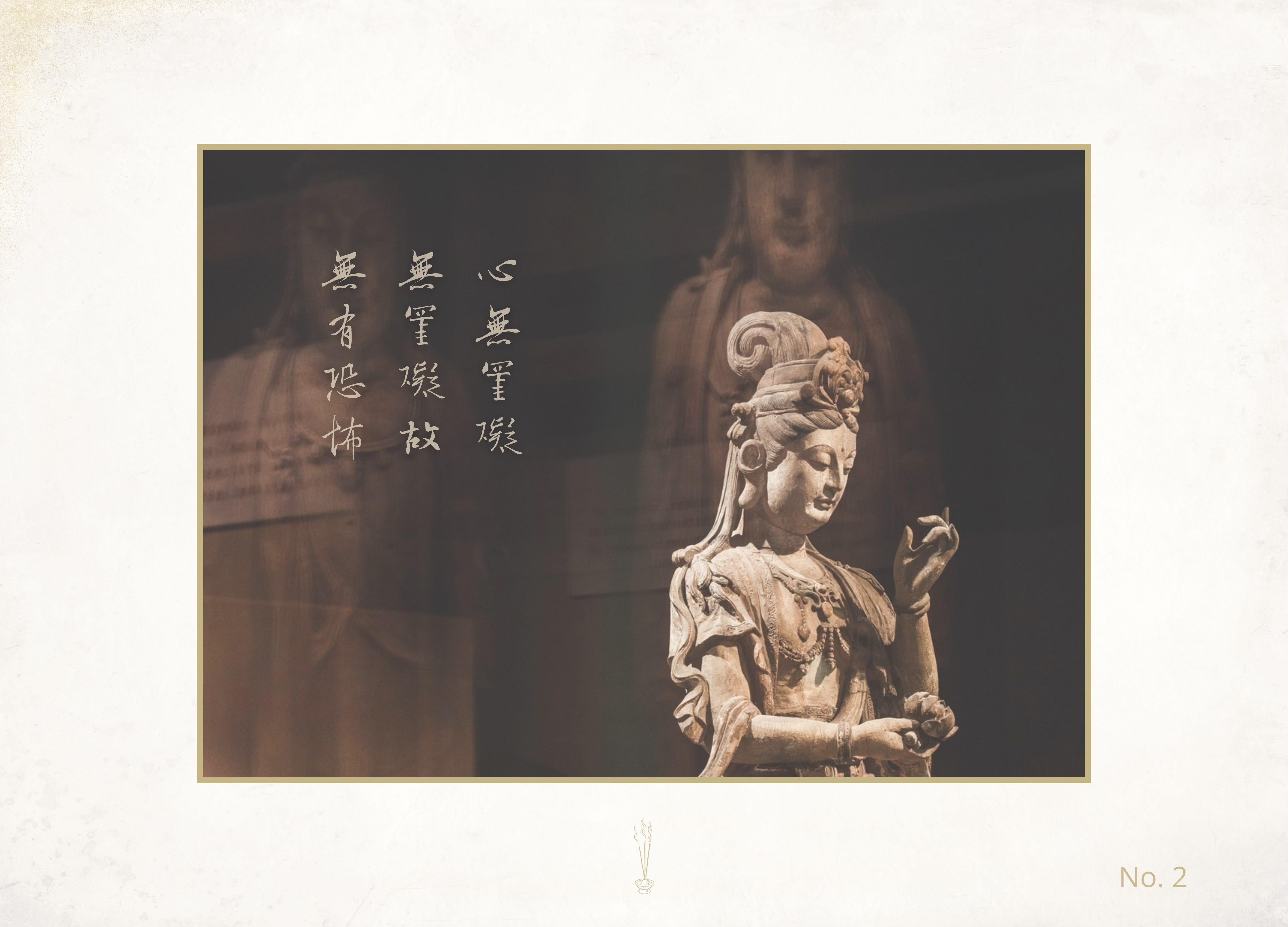
There was a period in which I’ve been wrestling with a notion from the Heart Sutra,
…live with an unhindered mind,
Without hindrance, the mind has no fear.4
I know it teaches us the lesson of seeing the emptiness of all things in the phenomenal world. I know it is not taking a nihilistic position when the script talks about the empty nature of all the transitory, impermanent things in the material world.
It suggests to me that I should not be controlled by the thoughts and emotions arising from my entanglements with the external world, which is constantly changing, for all such identifications between “I” and the world, and artificial distinctions, are arbitrary.
In this sense, even my existence is dependent on something unsubstantiated and, therefore, not real. And spiritual liberation arises from not being attached to those external things that trigger our desires, pains, and distress.
Even if I can accept that my heart and mind are constantly intertwined with all the appearances in the world that are undergoing a process of construction and destruction, it still takes time and experiences to come to peace with this understanding.
The sense of existential distress, all the sadness, fear, and suffering, will still be there. A melody from a familiar piece of music can trigger my memory, evoking long-buried pains from loss.
Yet, I think the idea of the unhindered mind allows us to see the emptiness around us, not denying the world, but loosening the knot between “I“ and appearances.
I can see now that I was suffering from those pains and distress. And because we can see, we are freed from the existential pains.
Realizing that everything around me is transitory, I’ve felt an increasing gratitude for the simple joys of life. After all, we are temporary beings, lodged somewhere on this earth, like the clouds that move and disappear, the wind that blows and flies into the sky.
Fung Yu-lan, “The Human World,” in Chuang Tzu: A New Selected Translation with an Exposition of the Philosophy of Kuo Hsiang (Beijing: Foreign Language Teaching and Research Publishing, 2016), 49.
Yan Hui 顏回 is a favored disciple of Confucius. Chuang Tzu uses Confucius and Yan Hui as characters in his stories and parables.
Fung Yu-lan, “The Great Teacher,” 82.
Kazuaki Tanahashi, The Heart Sutra: A Comprehensive Guide to the Classic of Mahayana Buddhism (Boston & London: Shambhala, 2014), 4.
This article reminded me something I thought about emptiness. How the term ‘emptiness’ or ‘void’, even if there’s another definition behind the two, gets seen as something negative and to be fixed/filled/replaced. While the opposite is true for Taoists, who want to travel to that emptiness. The freedom of emptiness gets seen as a jail, in most of the world’s eyes. Well written :).
Yuxuan, I especially like your first section which shows wisdom progression and maturity! I've been thinking about emptying. Still can't quite put my pulse on this sense of detachment, won't it be a bit cruel? Of course, I would feel more sad if it's someone closer to me more than say a stranger. So would the degree of letting such thoughts come and go be different? Or everything is to be received and reflected equally.