


Poetry, especially the lines of Tao Yuanming (365-427 A.D.)1 and Wang Wei (701-761 A.D.), has always been for me a resting place for inner serenity. As I grow older, I have come to realize that it has become a spiritual nourishment that I can hardly find anywhere else.
A distinctive feature of classical Chinese poetry is its fusion of philosophical insight, intuitive grasp of worldly life, and exquisite representation of nature. Some poets of the Wei-Jin period (220-589 A.D.) chose poetry as the medium for their philosophical expression.
Lin Yutang (1895-1976) once wrote,
“The whole tenor of Chinese thought, too, encourages the writing of poetry as the highest crown of the literary art…Poetry is essentially thought colored with emotion.”2
I often discover more eye-opening insights from these poems than from some academic works that tend to dull one’s senses.
So I begin this new adventure to share my wanderings through these old lines of the past. The selected verses, I believe, can find us at the right moment, reminding us to slow down, live gently with awareness, and return to what truly matters.
The season of retreat
Falling leaves, a chill in the early morning, and shorter daylight. It’s the appearance and rhythm of autumn.
Nature does not speak. Yet through its silent transitions, it guides us toward reflection and repose.
It is a time of retreat, introspection, and quiet renewal.
In the hours of stillness, I revisited one of Wang Wei’s lesser-known poems.
Drinking ale with Pei Di

When I drink ale with you, you are naturally relaxed;
Human nature is changeable, like rolling waves.
Old acquaintances, white-haired, may yet put hands on swords;
Gentry who first achieved eminence laugh at those first taking up office.
Plants in their colors have all passed through a soaking from light rain;
Flowered branches will soon tremble in the chill of the spring breeze.
What use is it to inquire about the floating clouds of worldly affairs?
It is better to recline in reclusion and be sure to eat well.

Wang Wei, The Poetry and Prose of Wang Wei, vol. 1, trans. Paul Rouzer (Boston/Berlin: De Gruyter, 2020), 378.
Pei Di (approximately 716-?), himself a poet, was a close friend of Wang Wei. In this poem, Wang Wei advises his younger friend not to be consumed by worldly entanglements but to cherish simple joys instead.
Both poets served as officials in the capital Chang’an.
Politics, in both traditional societies and modern states, is the arena for the ambitious. Seeking power, titles, and status has always been a human impulse.
I don’t know whether human nature is pliable to change or not, but I do know that circumstances often confuse us, and the “rolling waves” can be formidable, leading to regrettable choices.
After wading through the muddy waters of the world, how many can preserve the purity of their spirit?
If light, dark, and shadows coexist in the natural world, then so do they in human life.
The floating clouds know that worldly affairs are just transitory and fortuitous. Seeing their impermanence and the shortness of our own lives, perhaps we can learn to ask: what truly matters?
Life at Wangchuan
In his early forties, Wang Wei acquired an estate at Wangchuan 輞川, near Lantian 藍田, south of Chang’an.
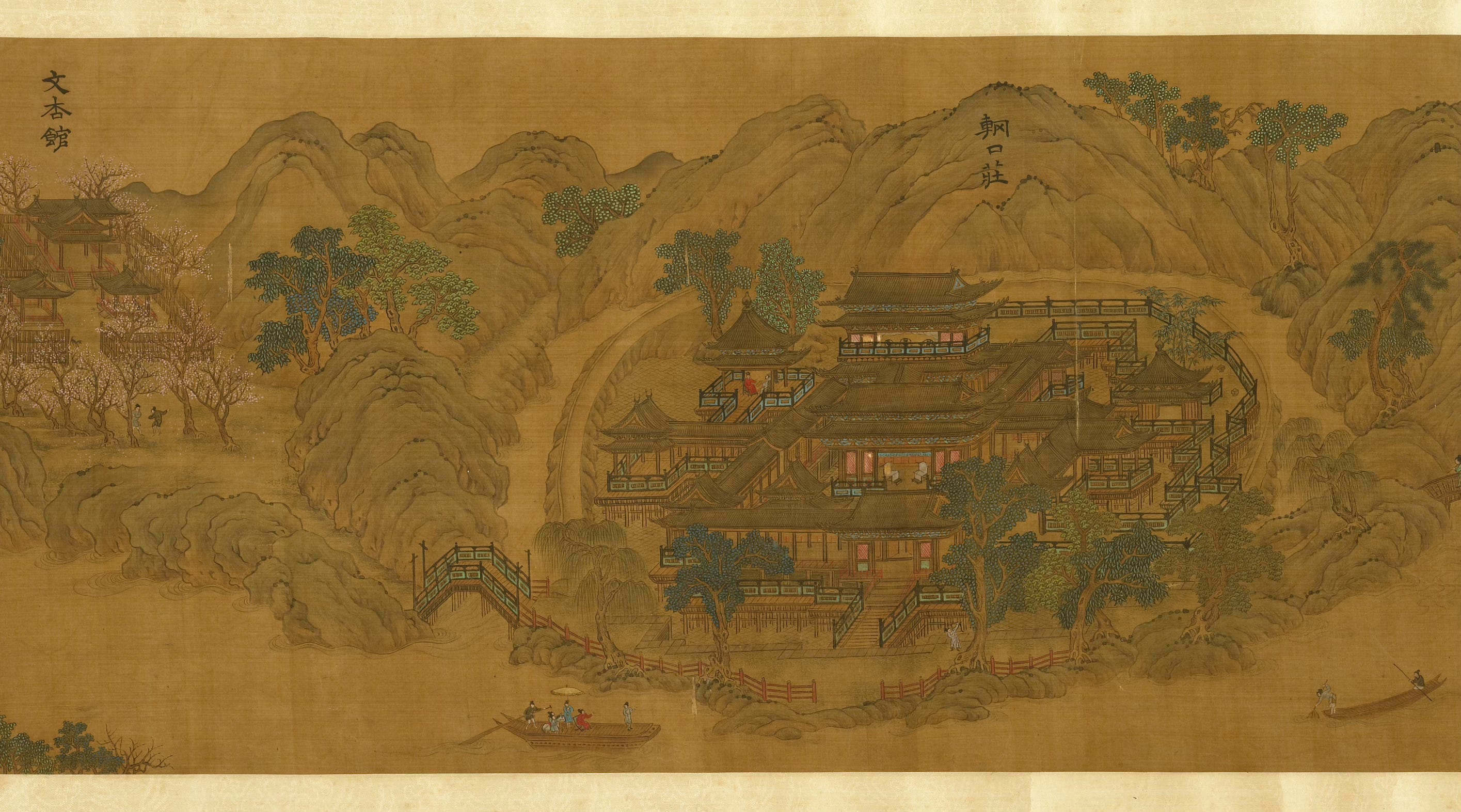
There, he divided his time between quiet retirement and court duties. For more than a decade, Wang Wei and Pei Di wandered through its valleys, rivers, and small forests, writing some of the best pastoral poems in Chinese literature.
Known as the poet-Buddha (shifo 詩佛), Wang Wei could seamlessly weave Buddhist thought, painting, and poetry into a unified art.
Su Shi’s 蘇軾(1037–1101), the great poet from the Song dynasty (960-1279), once remarked:
“When you carefully read a poem by Wang Wei, you see a painting within; and when you examine a painting by Wang Wei, you see a poem within.”
As a poet, painter, and musician, Wang Wei’s landscape poems are generally simple and straightforward, like silent meditation expressed in words. His mastery of this genre was unparalleled in the classical Chinese poetic tradition.
When reading his poems, one is often drawn into the scene, experiencing the natural surroundings through sight, sound, and sensation.
Dwelling in the Mountains: An Autumn Evening

Empty mountains after a recent rain:
The air, since evening, turns autumnal.
The bright moon, amid the pines, shines.
The clear stream, over rocks, flows.
...

Pauline Yu, The Poetry of Wang Wei (Bloomington: Indiana University Press, 1980), 196–97.


Magnolia Enclosure

Autumn mountains embrace the lingering light.
Flying birds follow companions ahead.
Brilliant blue-green — at times distinct and clear;
Evening mists without a place to be.


Pauline Yu, The Poetry of Wang Wei (Bloomington: Indiana University Press, 1980), 202.
The white moon, the clear stream, and the distant mountains depict a serene atmosphere of early autumn, while the “lingering” sunlight and mists are decorated with blue and green, the varying colors of nature.
With a few impressionistic strokes, we are led to see the painting with the poet’s sensitivity or read the poem with the painter’s eyes.
Apart from nature and contemplative Buddhist themes, Wang Wei also wrote poems in correspondence with various social circles, including court officials, Taoists, and Buddhist practitioners.
In this sense, the social aspect of his poems serves both communication purposes and as a way to commemorate friendships. Poems that addressed Pei Di are examples of this.
On the surface, Wang Wei appears as a half-hermit and half-official, between his Wangchuan estate and the court. But his life was not free of turbulence, both personally and professionally.
Yet in his poetry, emotion is often transformed into stillness. What is left unspoken does not indicate absence, but a profound awareness and acceptance. Sometimes, silence speaks deeply than words.
And words can dissolve, life drifting clouds, leaving us only the light of understanding.
Tao Yuanming 陶淵明 (365-427 A.D.), a poet from the Eastern Jin period (317-420 A.D.), and Wang Wei (701-761 A.D.) 王維, from the Tang Dynasty (618-907 A.D.), were both representatives of the pastoral/nature poems in classical Chinese literature.
Lin Yutang, My Country and My People (Beijing: Foreign Language Teaching and Research Press, 2009), 248–49.
Beautiful imagery and feelings to accompany us into the week! 🤍 And I'm glad you chose to feature the lesser-known poems of Wang Wei. I also like his 秋夜獨坐 "雨中山果落, 燈下草蟲鳴".
Thank you for introducing me to wang wei and for your insightful remarks.