


Friendship, in the old books, is described as something lofty but genuine, precious while exacting. It’s a rhythm between two minds.
With the passage of time, I’ve come to believe that it is fortunate to have the companionship of a true friend in life’s journey.
Lately, I have been reading Wang Wei’s poems about his exchanges with friends. Somehow, I find that I’m listening to that rhythm across over a thousand years.
On a Spring Day Going with Pei Di to Xinchang Ward to Visit the Hermit Lu and Not Encountering Him


The Peace Blossom Spring has always been cut off from wind and dust.
At the southern edge of Willow Market we visit a recluse friend.
Arrived at his gate we do not dare to write “common bird.”
Seeing bamboo why do we need to ask about our host?
Outside the city azure mountains are almost inside the room;
From eastern homes flowing waters enter the western environs.
Behind closed doors, he has written books for several years and months;
The pines he planted have aged with him and grown a scaly bark.

Pauline Yu, The Poetry of Wang Wei (Bloomington: Indiana University Press, 1980),188.
The Peach Blossom Spring is the home of the hermit Lü, located at Xinchang Ward, a region in Chang’an, the capital city of the Tang dynasty (618-907).
Wang Wei often moved between public duty at the central government and retreat at his Wangchuan residence (see the linked post below), keeping company with recluses, Taoists, and Buddhists. Pei Di was a close friend, a member of the poet’s inner circle.

On this spring day, they did not see Lü the hermit, yet Wang Wei implied that his friend kept the place open for them.
Their friend probably led a rather detached life. The phrase “cut off from wind and dust” (jue fengchen 絕風塵) symbolizes a spiritual, unattached way of living, free from the mundane, everyday concerns.
While dwelling there, looking at the bamboo and pine trees, the poet reflected on his friend’s daily life: working on his books while communing with nature.
The “phoenix” on the door
Wang Wei’s reference to the “common bird” brings us to an anecdote during the Wei-Jin period (220-589 AD).
Ji Kang (嵇康, 223–262) and his friend Lü An (呂安) were both representatives of the Seven Sages of the Bamboo Groves (zhulin qixian 竹林七賢). Lü An, known for his untrammeled bearing, would set out to see Ji Kang the moment longing struck, no matter the distance.1
One day, Lü An arrived to call on Ji Kang, but found him away. Ji Xi (嵇喜), the elder brother, came out to receive the guest. Lü An did not step inside. He took a brush, wrote a single character — feng 鳳 (means phoenix in Chinese)— on the door, and left.
Ji Xi was delighted to see it. He missed the irony of the stroke. The character feng 鳳 carries within it fan 凡 (common) and niao 鳥 (bird). The message was exact yet sharp: I came seeking the phoenix, not for a common bird.
The further implication is that Lü An did not intend to stain his dear friend’s household with a coarse word, despite the fact that he did not like the older brother, who was actually a good and capable scholar-official, but not as highly esteemed as his brother.
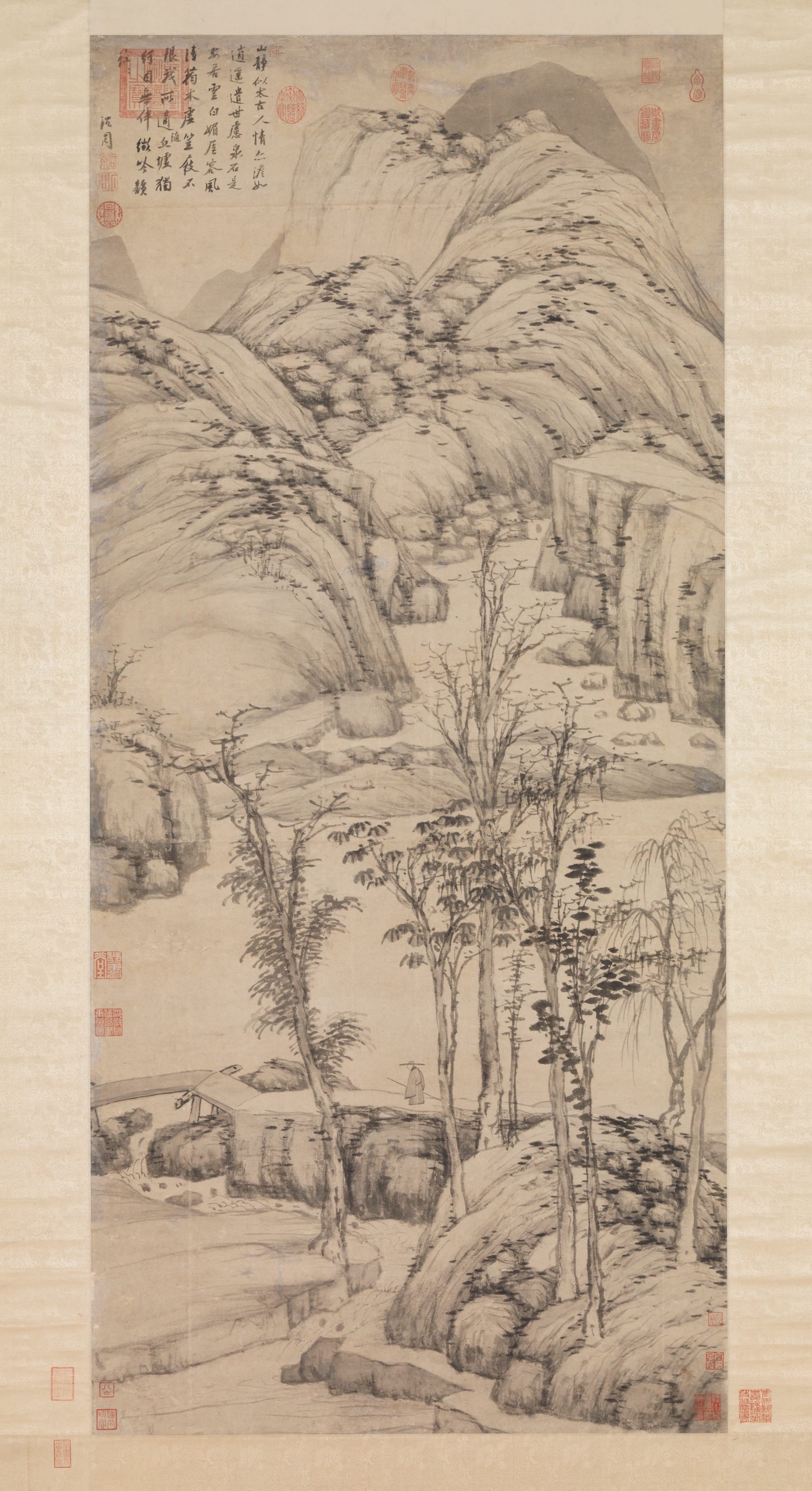
Bamboo, flowing water, and the unbound mind
In referring to this story, Wang Wei says that they dare not write the “common bird,” showing great respect for his recluse friend.
Hermit Lü’s household arrangements and the affinity with nature scenes showed them an alternative way of living. The bamboo groove symbolizes the hermit’s principled self-conduct.2
A heart-mind that is free and unbound can find ease and leisure in the simplicity of things, in the joy of nature.
The “azure mountains” and “flowing waters” become not objects in the external, natural world, but the essential companions of the hermit Lü, of the lingering images in Wang Wei’s poetic world.
Aristotle conceived of friendship as a bond between people with shared virtue.3 For Chuang Tzu, the friendship of the gentlemen is like mild and insipid water, yet it lasts.4
Lingering resonance (Yuyun 餘韻)
The hermit image was a frequent theme in traditional literary works.
We often come across the story of a person seeking the recluse in the deep mountains, yet not encountering that person, leaving readers to imagine.
Here’s another well-known poem in this spirit:
Under the pine trees I asked your disciple,
“My master’s gone to gather herbs.
He’s somewhere in this mountain,
How can I know, through all these deep clouds?”Liu I-ch’ing. Shih-shuo Hsin-yü: A New Account of Tales of the World (世說新語). Trans. Richard B. Mather (Ann Arbor: University of Michigan, 2002), 425.
In traditional China, plum, orchid, bamboo, and chrysanthemum represent cultivated character: the plum’s endurance, the orchid’s purity, bamboo’s upright integrity, and the chrysanthemum’s unworldly ease.
Aristotle. Nicomachean Ethics. Trans. Terence Irwin. (Indianapolis/Cambridge: Hackett Publishing Company, 2019), 144.
Burton Watson, “The Mountain Tree,” in The Complete Works of Zhuangzi (New York: Columbia University Press, 2012), 161.
Yuxuan, beautiful tribute to the beauty of friendship! You packed lots in a clear, concise manner. From 四君子 to 賈島 - I particularly love the line 雲深不知處, even gifted my brother a 盖碗 with a landscape painting for his tea moments to draw on this spirit.
an excellent poem at the end - my nephew wrote it for his calligraphy class and gifted it to my mother. a lovely, wistful piece.