


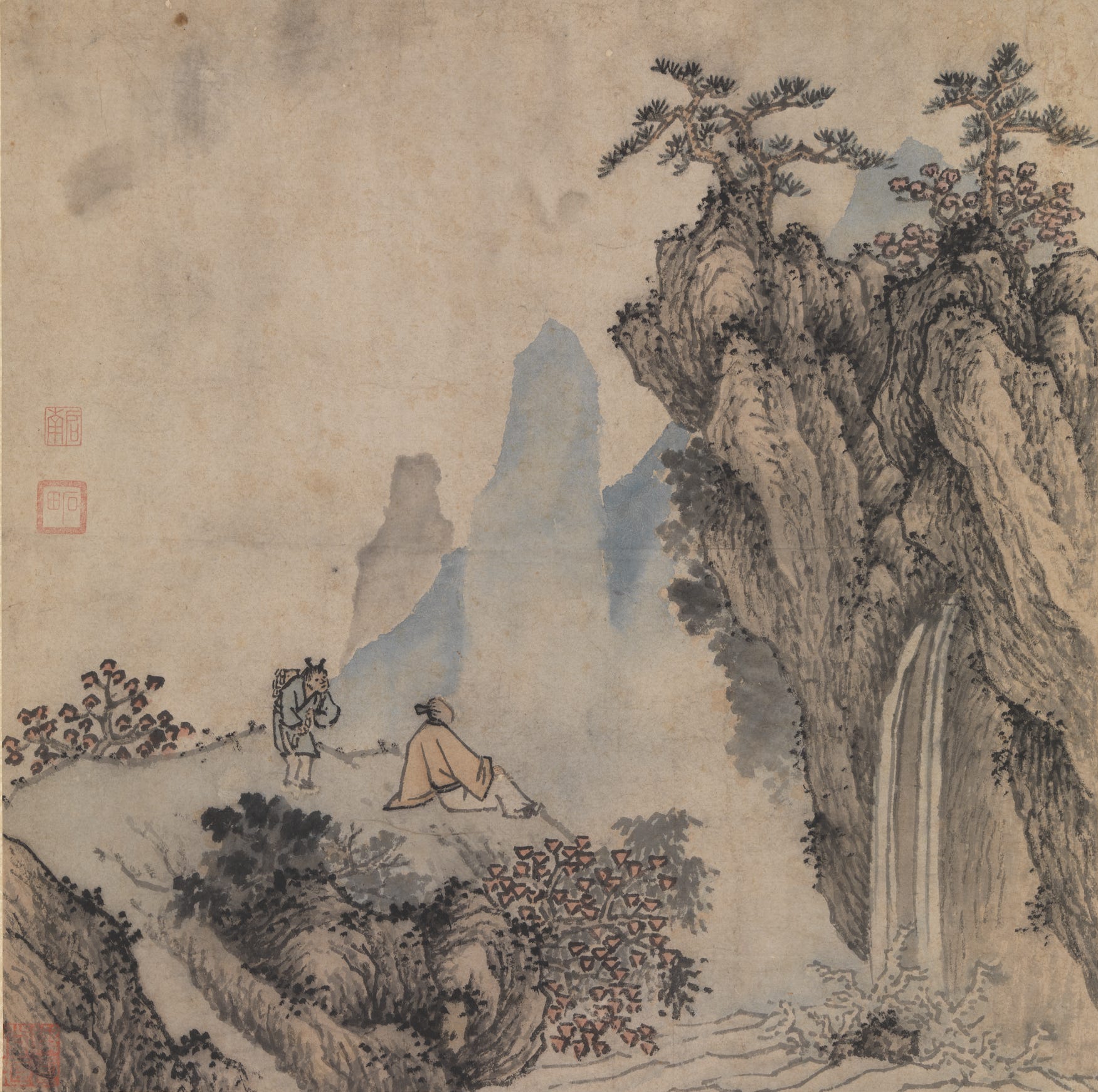
I sing, and moon rocks back and forth;
(wo ge yue paihuai 我歌月徘徊)
I dance, and shadow tumbles into pieces.
(wo wu ying lingluan 我舞影凌亂)

Sober, we’re together and happy. Drunk,
(xing shi tong jiaohuan 醒時同交歡)
We scatter away into our own directions:
(zui hou ge fensan 醉後各分散)

Intimates forever, we’ll wander carefree
(yong jie wuqing you 永結無情遊)
And meet again in Star River distances.
(xiangqi miao yun han 相期邈雲漢)

David Hinton, trans., “Drinking Alone Beneath the Moon,” in The Selected Poems of Li Po (New York: New Directions, 1996), 43.
This is one of Li Bai’s most recognizable gestures: turning solitude into a personal ceremony.
Drinking wine alone can feel bitter for some, yet it is when Li Bai enters the mode of poetic creation. With the moon and his shadow as companions, it became his own ritual of being with himself.
If wine is the medium through which Li Bai releases himself from the weight of worldly expectations, the road reminds him of the immediate, concrete reality.
The road in his poems is not just a road. It reflects his sense of obstruction, a political map of what refuses to open.
Quite often, his wandering is romanticized as freedom, with moonlight, shifting landscapes, and carefree drifting within and beyond society. On the surface, it is so. But the deeper truth is harsher.
He wandered because the world he wanted a place in did not easily admit him.
The road as diagnosis
About 735, the year when he turned thirty-four, Li Bai was still struggling to find his path in politics. After staying in Chang’an for several years, he decided to travel south. A question still lingered in his mind: how can he proceed when the gate just did not open?
Two important poems from this period are records of his inner journey. The first is “Hard is the road,” a title that already carries assessment. Perhaps, sensing that he was at the crossroads of his life, in the face of unfulfilled ambitions, the poet was at a loss for how to proceed:
Pure wine in golden cup costs ten thousand coppers, good!
Choice dish in a jade plate is worth as much, nice food!
Pushing aside my cup and chopsticks, I can’t eat;
Drawing my sword and looking round, I stamp my feet.1
The setting in the poem is literal, with food, wine, and a heart disturbed, but the emotion is existential.
Li Bai probably understood better than many of his contemporaries that sometimes it depends on the right circumstances and conditions to exercise his talent. Or perhaps, the difficulties he faced in his political pursuits, ironically, became the material he worked with in his poetry.
If he pushed harder against those invisible structures, the more he would feel the road as a wall. In this sense, the images of obstructions strike deeper than travel notes:
I can’t cross Yellow River: ice has stopped its flow (欲渡黃河冰塞川),
I can’t climb Mount Taihang: the sky is blind with snow (將登太行雪滿天).
This blockage is both geographical and experiential. No one was there to point him in a clear direction. He had to first figure it out by himself.
Yet he still refused to give up in despair. Self-rescue was all he had:
A time will come to ride the wind and cleave the waves (長風破浪會有時),
I’ll set my cloud-white sail and cross the sea which raves (直挂雲帆濟滄海).
To rise above the present shackles, Li Bai chose to be fearless and defiant with sobriety.
The impossible passage
We often imagine that once we climb over one mountain, the slope will get easier to walk through. Yet, life is hardly a linear path.
The next crisis does not arrive with notifications. The wave does not ask whether we have rested.
Li Bai seems to know this early: even after one ascent is completed, another begins, often steeper and more overwhelming.
The second poem, “Hard is the Road to Shu,”2 expands the sensation of obstruction into a vision of impossibility:
Oho! behold! how steep! how high!
The road to Shu is harder than to climb the sky.
…
Above stand peaks too high for the sun to pass o’er;
Below the torrents run back and forth, churn and roar.
Even the Golden Crane can’t fly across;
How to climb over, gibbons are at a loss.
What tortuous mountain path Green Mud Ridge faces!
Around the top we turn nine turns each hundred paces.
Looking up breathless, I can touch the stars nearby;
Beating my breast, I sink on the ground with long sigh.
This perilous nature scene is symbolic and metaphysical — a picture of what it feels like to move through a world where the path is full of uncertainty, and the slightest misstep means irreversibility.
Perhaps some paths in life are structured as refusal.
Li Bai was aware of the dangers involved in this adventure, as he asks why he would come this far in the poem.
We all ask similar questions, though our objects differ. Do we engage in activities for their intrinsic value, or for some intended result? Only we can know the struggle. Only we can measure the range of our trajectories.
A second return to Chang’an (742-745)
Throughout his life, Li Bai was driven by the ambition to establish himself in public life. When reality ran counter to his wishes, he would wander, mingle with Taoist practitioners and recluses, and dwell on mountains.
By 742, he had already lived one cycle of active engagement and retreat. Yet, fate brought him once more toward the capital. This time, the political world opened the door for him not through conventional bureaucratic channels, but through a Taoist connection.
At this time, Li Bai was living in reclusion with the Taoist Wu Yun 吳筠, in Shanzhong 剡中 (near today’s Shaoxing, Zhejiang), a place historically known for its recluse culture.3 When Wu Yun was invited to court, he recommended Li Bai to the emperor Xuanzong 玄宗. Naturally, the poet was summoned to serve as a literary attendant, a court poet.
This opportunity sounds really like fulfillment. And Li Bai was full of hope and excitement:
I’ll leave my family and journey to the west.
Looking up at the sky, I laugh aloud and go.
Am I a man to crawl amid the brambles low?4
After years on the road, the poet finally steps into the heart of the world he intended to be. However, the Tang court was already showing some visible signs of inner rot.
Under the new prime minister, Li Linfu 李林甫 (683-753), the political atmosphere had grown corrosive. With the emperor growing less attentive to state affairs, Li Linfu and his faction started to dominate court politics, purging political opponents who did not bow to his influence.
The year before was a turning point in Tang’s political history. Zhang Jiuling 張九齡 (678-740), the last chancellor who helped build the Heyday of Kaiyuan (開元盛世) — a period of growth and prominence, was exiled. This produced a chilling effect in the capital’s political circles.
Yet, it is here that the Tang presents its paradoxical face.
Culturally, the dynasty still projected its openness and confidence. Taoism was esteemed by the court. Religions and ideas circulated widely. The capital hosted flourishing communities of Buddhism, Christianity (the Nestorian sect, 景教), Islam, and Manichaeism (a 3rd-century religion from Persia). The surface looks bright.
But a luminous surface could not prevent decay beneath it. The building of an empire is slow, but its crumbling can be swift.
While working in the capital, Li Bai also had time to slip out of the court’s sphere, walking into the mountains. In one well-known poem, he described the joyful, peaceful trip to Mount Zhongnan 終南山. There, he spent the night with his recluse friend, temporarily forgetting worldly concerns:
At dusk I leave the hills behind,
The moon escorts me all the way.
..
We sing the songs of wind and pine,
And stars are set when singings end.
I’m drunk and you’re merry and glad:
We both forget the world is sad.5
In this simple moment, the poet’s heart is temporarily relieved from the toxic political environment.
After the court incident with Gao Lishi (see part 1), Li Bai had faced constant slander and political pressure, allegedly from Yang Guifei, the emperor’s favored consort. Perhaps he did not expect that a poem, a literary creation in praise of beauty, could eventually be used to turn against him.
By 745, he resigned from office.6
Leaving (745 and after)
These two years of working at the center of power gave Li Bai firsthand experience in politics. His withdrawal from it, perhaps with a sense of relief, brought a sharper clarity and a moral boundary.
Soon after, he expressed open contempt for the coercive use of power and a circle he could not identify with:
How can I stoop and bow before the men in power
(an neng cuimei zheyao shi quangui 安能摧眉折腰事權貴)
And so deny myself a happy hour?7
(shi wo bude kai xin yan 使我不得開心顏)
From now on, he could finally leave Chang’an behind.
For the next ten years, he became what the court could not contain: a wandering poet—leaving footprints across mountains and rivers, drinking and mingling with scholars and recluses, and slowly letting the Taoist way move from ideas into lived practice.
Next on Li Bai:

The title of this poem is “Hard is the Way of the World (xing lu nan 行路難).” The Chinese lines are 「金樽清酒斗十千 玉盤珍羞值萬錢 停杯投箸不能食 拔劍四顧心茫然」
Li Bai, Selected Poems of Li Bai, trans. Xu Yuanchong (Changsha: Hunan People’s Publishing House, 2007), 49.
Shu 蜀 is today’s Sichuan Province. The Chinese lines cited here are:
噫吁戲 危乎高哉!
蜀道之難 難於上青天
…
上有六龍回日之高標
下有衝波逆折之回川
黃鶴之飛尚不得過
猿猱欲度愁攀援
青泥何盤盤
百步九折縈巖巒
捫參歷景仰脇息
以手撫膺坐長歎
Selected Poems of Li Bai, 45.
Qu Tuiyuan 瞿蛻園 and Zhu Jincheng 朱金城, eds., “Nianpu 年譜,” in Li Bai ji jiaozhu 李白集校注 (A Critical Edition of Li Bai’s Collected Works with Commentaries), vol. 2 (Shanghai: Shanghai guji chubanshe, 1980), 1754.
The title of this poem is “Parting from My Children at Nanling for the Capital (南陵別兒童入京).” The Chinese lines read 「余亦辭家西入秦 仰天大笑出門去 我輩豈是蓬蒿人?」
Selected Poems of Li Bai, 99.
The poem is titled “Descending Zhongnan Mountain and Meeting Husi the Hermit (過終南山斛斯山人宿置酒).” The Chinese lines cited are: 「暮從碧山下 山月隨人歸 長歌吟松風 曲盡河星稀 我醉君復樂 陶然共忘機」
Ibid., 109.
Li Bai ji jiaozhu, 1756-1759.
The title of this poem is “Mount Skyland Ascended in a Dream — A Song of Farewell (夢遊天姥吟留別).”
Selected Poems of Li Bai, 129.
I like those lines you wrote - that life is not a linear path. Li Bai, like Du Fu, wandered and walked the road of hardship toward literary immortality!
Laid out his story beautifully, thank you, good to know this character better. 🙏🏻