

Naturalness (Ziran 自然)
Taoism’s first principle.

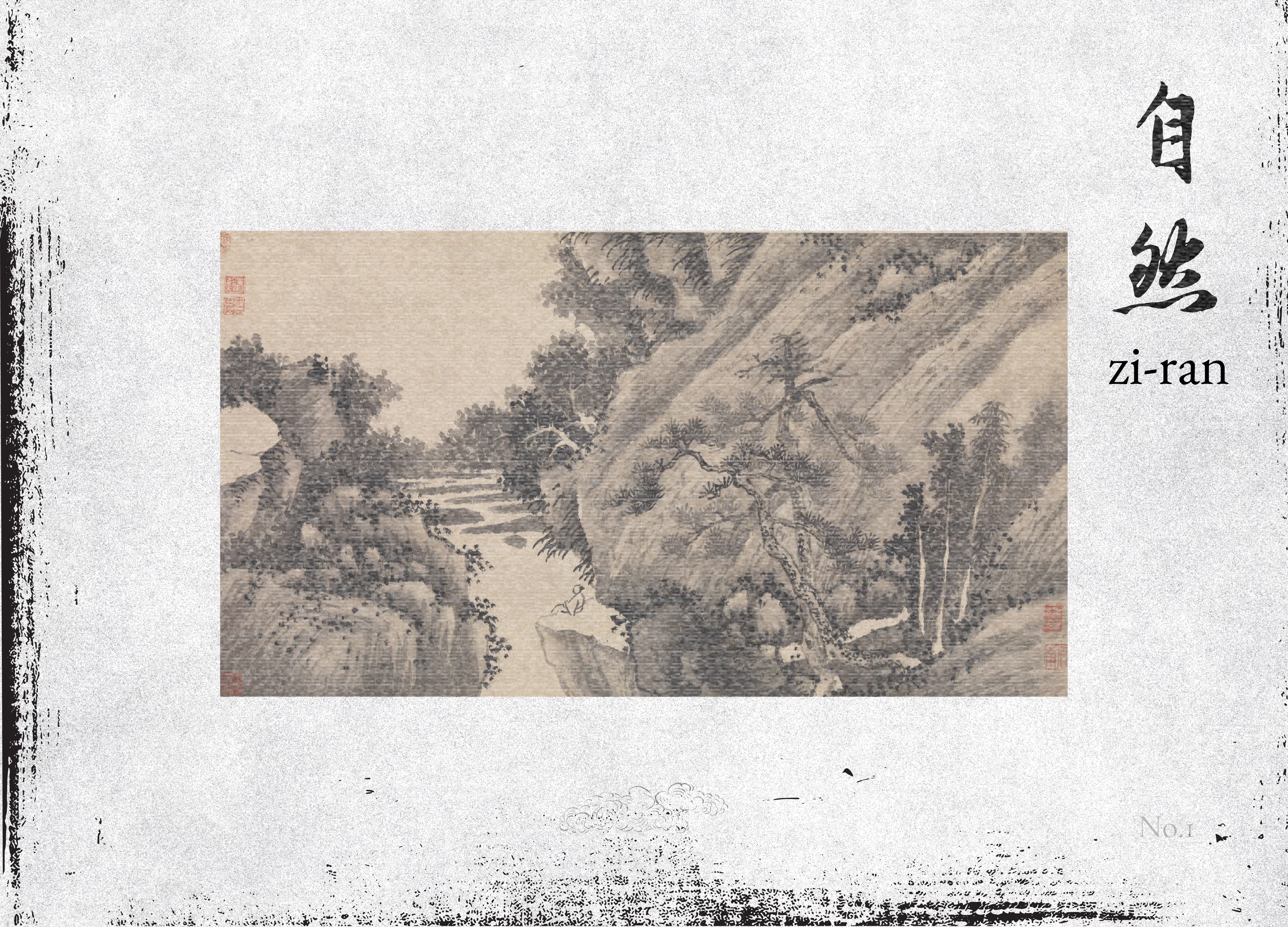
Ziran 自然, in the Taoist system, can be translated as naturalness or spontaneity. It means that which is so by itself, “self-formed,”1 or “so of (it)self.”2
When we refer to something as natural, we are describing the way it is. Something on its own also implies a state of innate independence, wholeness, and autonomy.
This leads us to the philosophical meaning of naturalness.
The idea of ziran
The myriad things spontaneously operate and evolve by themselves without external meddling, intervention, and interruption.
In other words, things self-transform in accordance with their inborn nature. This is the natural order.
The Taoists awaken to the natural order of the universe by learning that the Tao follows the principle of naturalness. As Lao Tzu described,
Man models himself on earth,
Earth on heaven,
Heaven on the way,
And the way on that which is naturally so 道法自然.3
From a different angle, we can understand that naturalness is the principle of the cosmos, and the Tao operates silently by it.
The Tao Te Ching refers to the Tao as the fountainhead of the myriad things in the world. It creates and empowers, but it does not appropriate, dominate, or contend,
Thus the way (the Tao) gives them life and rears them;
Brings them up and nurses them;
Brings them to fruition and maturity;
It gives them life yet claims no possession;
It benefits them yet exacts no gratitude;
It is the steward yet exercises no authority.
Such is called the mysterious virtue.4
Following the Tao, on an existential level, inspires a spontaneous freedom within for the Taoists. To embody the liberating spirit, it becomes essential that they practice wu-wei to follow what is natural, seeing that the myriad things are on their way to find their own natural paths.
In this sense, naturalness is the highest value Taoists can aim for in life.
All things in the world can find and manifest their unique state by being natural. And any intentional act of meddling will destabilize the natural order.
Therefore the sage desires not to desire
And does not value goods which are hard to come by;
…
In order to help the myriad creatures to be natural and
to refrain from daring to act.5
With this precondition, the Taoists, being aware of the principle of naturalness, carefully play the assisting role in preserving the way things are.
On forcing vs becoming natural
How do we apply the principle of naturalness in life? And is there a way to know we live in tune with it?
Let’s illustrate this with an example. A student has a knack for music. During his formative years in school, he practiced cello and went through all the critical stages of becoming a musician: practice, lessons, and recitals. He truly loves music and wants to devote his life to it. All things look promising for his musical career path. What could go wrong that forces him to change his professional pursuits?
Just about the time he entered university, his parents forced him to change from music studies to any field that they considered pragmatic. He is not bad at academic subjects, but his true passion is music. However, he eventually followed his parents’ advice and majored in architecture instead of music.
From now on, he will not fulfill his dream of becoming a musician in the long run. In this case, the parents intervene and meddle arbitrarily with the student’s career, which causes him to derail his natural path.
In another scenario, the student is still passionate about music. He gets all the support from his parents throughout his formative years. And they have no disagreement with him in choosing a musical career for the rest of his life.
Unfortunately, the student has an accident, which prevents him from practicing cello as a result of his physical condition. Therefore, his natural path as a musician is interrupted by a sudden injury. Yet, even his misfortune is part of the spontaneous evolution of things in the universe, in its mysterious and constant transformation.
In the third scenario, the student is progressing in his music career. But he decides to increase his knowledge about the world by traveling and studying. He has realized that being a great musician is not just about having superb technique and masterful execution in performances.
More importantly, it is about the moral fiber and soul of the musician, or, to put it differently, what is above and beyond music itself. So, he immerses himself in studies of all kinds and gets involved with worldly experiences.
On the surface, it seems that he distracts himself from the one thing that truly matters to his profession, which means delaying the progress on his natural path.
However, he has an internal drive to enrich his life experience, which is part of his transformation as a musician. Therefore, in this case, his overall process of naturalness is not harmed because he makes the voluntary decision to temporarily reduce his musical activities to become a well-rounded person and a musician.
He is ready to be with the spontaneous flow of life.
Observe, untangle, flow
We can understand and appreciate the beauty in preserving the natural order of things. When we look at ourselves and the lives of others through the lens of naturalness, we capture the essence of spontaneous being, the way we all are, and the potential and possibilities embodied within.
We see people with a knack for words, numbers, dancing, painting, singing, systems thinking, and engineering. Some deviate from the natural path and struggle continuously. We also encounter people who find their own pace and rhythm in life.
Therefore, the natural path means aligning one’s natural endowment with creative explorations to form a singular, spontaneous state of existence.
There will be obstacles and roadblocks in our life’s journey, particularly if we charge into a course that is unconventional in the eyes of others but is fundamentally natural to us.
We may be intrigued by some of these questions. Why do we love music? Or books, movies, sports? Why does the heart keep beating while we are alive? Why do we walk and run? You can always think of reasons to justify that affinity. But it is essentially a natural sense of liking and a spontaneous action, unforced and not imposed by external intervention.
We lose naturalness once we force it with intention and consciousness and meddle in the natural process with arbitrary will and schemes.
Naturalness, therefore, is essentially about aligning with what is proper to our inborn nature in the midst of discovering who we are in life.
Tao Yuanming (365 - 427 AD), a great poet who lived through some tempestuous and dark times in ancient China, is a perfect example of restoring his life to naturalness from the pains and turbulences of a public career. As his poem below describes his state of living,
Unfit for worldly ways from youth,
In nature’s beauties I rejoice.
Enmeshed in public life,
From home I’d strayed for thirteen years.
The cage-bird languishes for its woody shelter,
The pond-fish pines for its native pool.
Down south I plough up the wastes,
Happy to be my humble self.
My homestead boasts some ten mu of land
With eight or nine rooms all told.
Elms and willows shade the back eaves,
Plum- and peach-trees line the front hall.
Hamlets lie scattered in the hazy distance,
Light smoke curls up over them.
Dogs are heard in the deep lane,
Atop the mulberry crows the cock.
Clean and tidy is my home,
Restful are the empty rooms.
A captive in the cage for years.
Back to nature I’ve found my way.

Tao Yuanming, The Complete Works of Tao Yuanming, trans. Tan Shilin (Hong Kong: Joint Publishing, 1992), 24–25.
For Tao Yuanming and each of us, living in the human world, with all the noises, lures, and distractions, can feel like walking with shackles and chains.
If we ignore what our heart and inner voice tell us, we will easily overwhelm ourselves in the midst of unconscious drifting, losing the possibility of living a genuinely natural, unique, and beautiful life.
We will be trapped in the cage of life without even realizing our plight.
We are not retreating from living by relinquishing what is external to the essence of a natural life. As we peel off this life’s illusions and false appearances picked up along the way, we gradually reach the state of naturalness, from which we can spontaneously arrive at a state of harmony and unity with our inner self and dwell in inner serenity.
We are not becoming something new. We are simply returning to the natural home of our spirit.
More on ziran/naturalness:


Lin Yutang. The Wisdom of Laotse (Beijing: Foreign Language Teaching and Research Press, 2009), 96.
Liu Xiaogan, “Daoism: Laozi and Zhuangzi,” in The Oxford Handbook of World Philosophy, ed. William Edelglass and Jay L. Garfield (Oxford University Press, 2011), 50.
Tao Te Ching, trans. D. C. Lau. (London: Penguin Classics, 1963), 30.
Ibid., 58.
Ibid., 71.