


In moments of parting, we are often reminded, intuitively, that we are staying for a while.
A change in our life situations is reflected in our minds, emotions, and decisions.
Perhaps, in such occasions of departure, the notion would dawn upon us: the world we know looks like a place we are passing through.
Impermanence becomes a lived reality.
We may even question whether we can claim that familiar space as home, as a shelter, or somewhere secure.
A door closes in the heart. And the mind is already set on what’s next.
Sojourning (ji 寄)
There is an old character for this in Chinese poetry and Taoist writings, ji 寄,1 meaning to sojourn, lodge, or stay as a guest.
It suggests a Taoist view that we are temporarily housed in a place. The world is like an inn, and we are simply living in a borrowed room.
There is a sober, inner lucidity in this Taoist perspective. If life is like a temporary lodging experience, then it is not meant to be clenched. And if we get this, then we are not likely to get ourselves tangled in a story of possession.
Untangled. Detached. And internally liberated.
But it is always easier to process this intellectually than experientially. Tao Yuanming 陶淵明 (365-427) expressed such feelings and his sorrows:
Luxuriant is the tree in blossom
It has planted its roots here (caicai rongmu jiegen yu zi 采采榮木 結根於茲).
In the morning it displays its flowers;
By the evening it has already lost them (chen yao qi hua xi yi sang zhi 晨耀其華 夕已喪之).
‘Man’s life is like a traveller’s stay’”
Yet there is time for suffering (rensheng ruoji qiaocui you shi 人生若寄 憔悴有時)
Quietly, I deeply brood;
In my heart I am sad (jingyan kongnian zhong xin chang er 靜言孔念 中心悵而)2
In the face of the traces of time on us, the greying hair, unfulfilled wishes in the heart, and the uncertainty lying ahead in this life, who can remain unperturbed?
Indeed, we are troubled by the sense of weariness, the quiet ache, that often arrives when we withdraw and look too closely, when we are most unprepared.
Despite viewing ourselves as guests, travelers, we continue to be troubled by interactions with our immediate realities.
Even though one learns to take oneself less seriously, that feeling of pain, suffering, fear, and anxiety still comes back, even more acute.
Cao Zhi 曹植 (192-232 AD), a poet from the early Cao-Wei 曹魏 dynasty (220-265 AD), was deeply troubled by the sense of rootlessness, the reality of a floating life. He wrote:
The whirling thistlebrush separates from its root and trunk
And is whirlblown, twirlblown, by the continual wind (zhuanpeng li ben gen piao yao sui chang feng 轉蓬離本根 飄搖隨長風)
Suddenly caught up in a gust of whirling wind,
I am blown up into the clouds (he yi hui biaoju chui wo ru yunzhong 何意回飈舉 吹我入雲中);
Higher and higher, unendingly upwards,
The paths of the heavens, how can they be exhausted?3
Cao Zhi resonated with the “roaming stranger” because he felt that he was drifting alone in this world.
This is sojourning with self-awareness still intact. The poet suffered from knowing it.
This shared sentiment reflects the tension between temporary staying and the wish to cling to something that fundamentally cannot be held. The mind can see the impermanence of things, but it still reaches for what is stable, guaranteed.
This is self-inflicted suffering. Seeing clearly is still not inner freedom.
Unoccupied (xian 閒)
The wanderer, or the traveller’s mind, cannot be liberated if it is deeply attached to the idea of the self, being driven by feelings, emotions, and varied sentiments, in changing life circumstances.
In other words, self-awareness guides toward inner clarity.
Yet it can still be captured by egocentricity and the senses in its interaction with the external conditions of the world.
There is the alternative path: to see through the world of appearances, including the perception of the self.
That is emptiness. The Buddhist notion of emptiness is written as kong 空 in Chinese. It denotes a state of mind, seeing the world as the impermanent flux of change, with everything in a process of construction and destruction, like the human cell renewing itself constantly, beyond our will, like the bubble that shatters, and the wind that flies away.
Emptiness is taken as the ultimate reality beneath the phenomenal world because the myriad things are locked in by external causes and conditions beyond themselves.
In this sense, all things, including the human person, are positioned in the state of dependent origination (hetupratyaya, yinyuan 因緣) — meaning the contingent relationships naturally arise and disappear, beyond individual wish, ungraspable, and therefore, are empty.
When the idea of emptiness becomes experiential, the mind becomes empty, allowing the Buddhists to rise above the illusions of phenomena.
This understanding of emptiness does not equal having an absolutely negative view of things. It indicates the practice of not anchoring.
The heart is no longer anchored to sentiment associated with the past, worries, fear, and anxieties about the future, and restlessness of the now. All emotions, desires, and expectations are fleeting, like particles that dissolve and disappear.
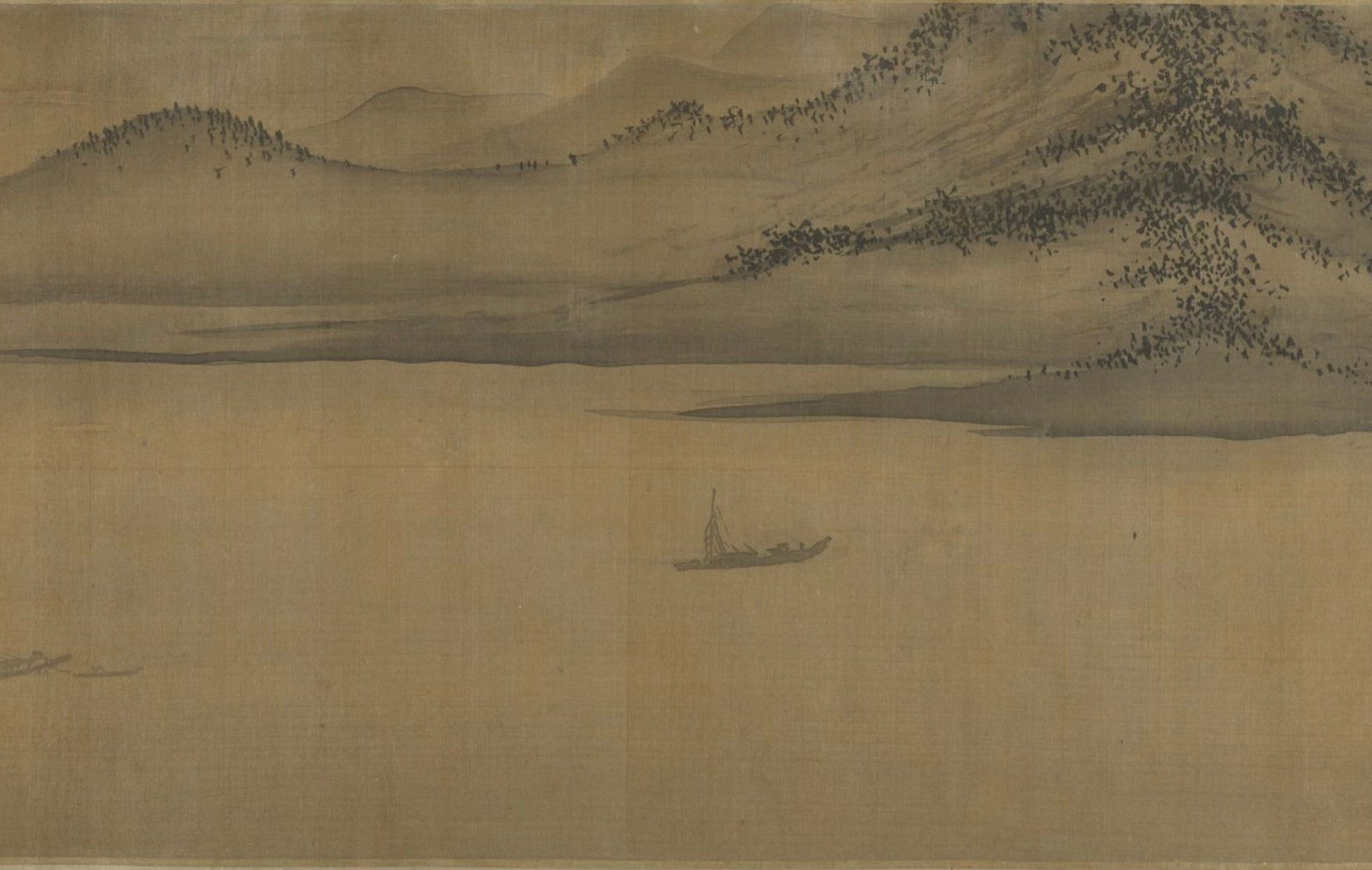
This is where the idea of being unoccupied (xian 閒) comes in. It does not mean having nothing to do, or choosing to do nothing, but a state of allowing the heart not to be captured by external things.
Wang Wei 王維 (701-761) describes this state of mind in his poem:4
Divided fields above Fu’s grotto:
A traveler’s stop within the clouds and mist.
On the high city wall I gaze at the far setting sun;
To the end of the reach azure mountains gleam.
Fire on the shore: a lone skiff rests for the night.
Fishermen’s homes: evening birds return.
Vast and distant, the sky and earth at dusk: 寂寥天地暮
My heart and the broad river are at peace. 心與廣川閒
Here, natural imagery is not only a sketch of what the poet sees, but also evokes the Buddhist state of mind.
To remain inwardly unoccupied suggests a tranquil state of being, an inner lucidity and calm derived from non-entanglement.
The traveler’s stop somewhere within the clouds, the distant mountains, the lone skiff, and fire on the shore constitute a picture of calm, harmonious arrangements. They register in the poet’s mind as peaceful, as the poet himself understood the empty nature of his own self, a temporary being.
In moments like this, the idea of xian 閒 is lived and tasted. It becomes a shared practice of the Taoists and Buddhists.
Parting can hurt, as it reminds us of the very act of clinging.
No matter how hard life can get, even if it often means going through the dark chapters, we know it will pass.
And, sooner or later, we may understand that to wander, drift, and get temporarily lodged somewhere in the world is unavoidable.
Yet, the heart will not be controlled by fear, as it is now liberated and released.
With constant practice in dissolving the self, we can still cultivate an inner space, inwardly unoccupied, with the heart flowing with the white clouds.
The idea of ji 寄 is closely related to Chuang Tzu’s thought on life and death: human life is like the qi that materializes in the human body, and death is but to return to the source of qi. Chuang Tzu’s philosophy of nondistinction (qiwu 齊物), which sees things from the perspective of the Tao, holds that life and death are the same.
According to Wang Shumin 王叔岷, a renowned scholar and textual critic on classical Chinese texts, a missing line — living is to lodge, and death is to return (生, 寄也; 死, 歸也) — from the existing thirty-three chapters of the Chuang Tzu is recorded in the Huainanzi 淮南子, a syncretist text from the early Han dynasty. Wang Shumin, Zhuang Xue Guankui 莊學管闚 (Beijing: Zhonghua Shuju, 2007), 89.
The Huainanzi, trans. and ed. John S. Major, Sarah A. Queen, Andrew Seth Meyer, and Harold D. Roth (New York: Columbia University Press, 2010), 252.
A.R. Davis, “The Tree in Blossom (rongmu 榮木),” in Tao Yuan-Ming His Works and Their Meaning (Cambridge: Cambridge University Press, 1983), 16.
George Kent, Worlds of Dust and Jade (New York: Philosophical Library, 1969), 46.
The Chinese lines of the poem read:
轉蓬離本根 飄搖隨長風
何意回飈舉 吹我入雲中
高高上無極 天路安可窮
類此遊客子 捐軀遠從戎
毛褐不掩形 薇藿常不充
去去莫複道 沉憂令人老
Pauline Yu, The Poetry of Wang Wei (Bloomington: Indiana University Press, 1980), 190.
Fu 傅 refers to a legendary statesman named Fu Yue 傅岳 during the Shang dynasty.
The Chinese lines of the poem read:
井邑傅嚴上 客亭雲霧間
高城眺落日 極浦映蒼山
岸火孤舟宿 漁家夕鳥還
寂寥天地暮 心與廣川閒
interesting, thanks. But I think “grasping the big, letting go of the small” is a good way to think about this. We don’t want to be bogged down by “the small”. Nor should we lose sight of “the big”, which a focus on emptiness could encourage.
閒=Moonlight (月) spilling into the room, the simple idleness of an unoccupied space. I love the notion of it, particularly relevant in our modern lives. Tao Yuan Ming did embody that! Was just reading a line by David Whyte: "Life seems to ask us to fall in love in many different ways, but none of us are ready for what we have to give up to get what we want."
There are cost and vulnerabilities in taking the path forward. We get hurt and we also receive love through that very same opening.