


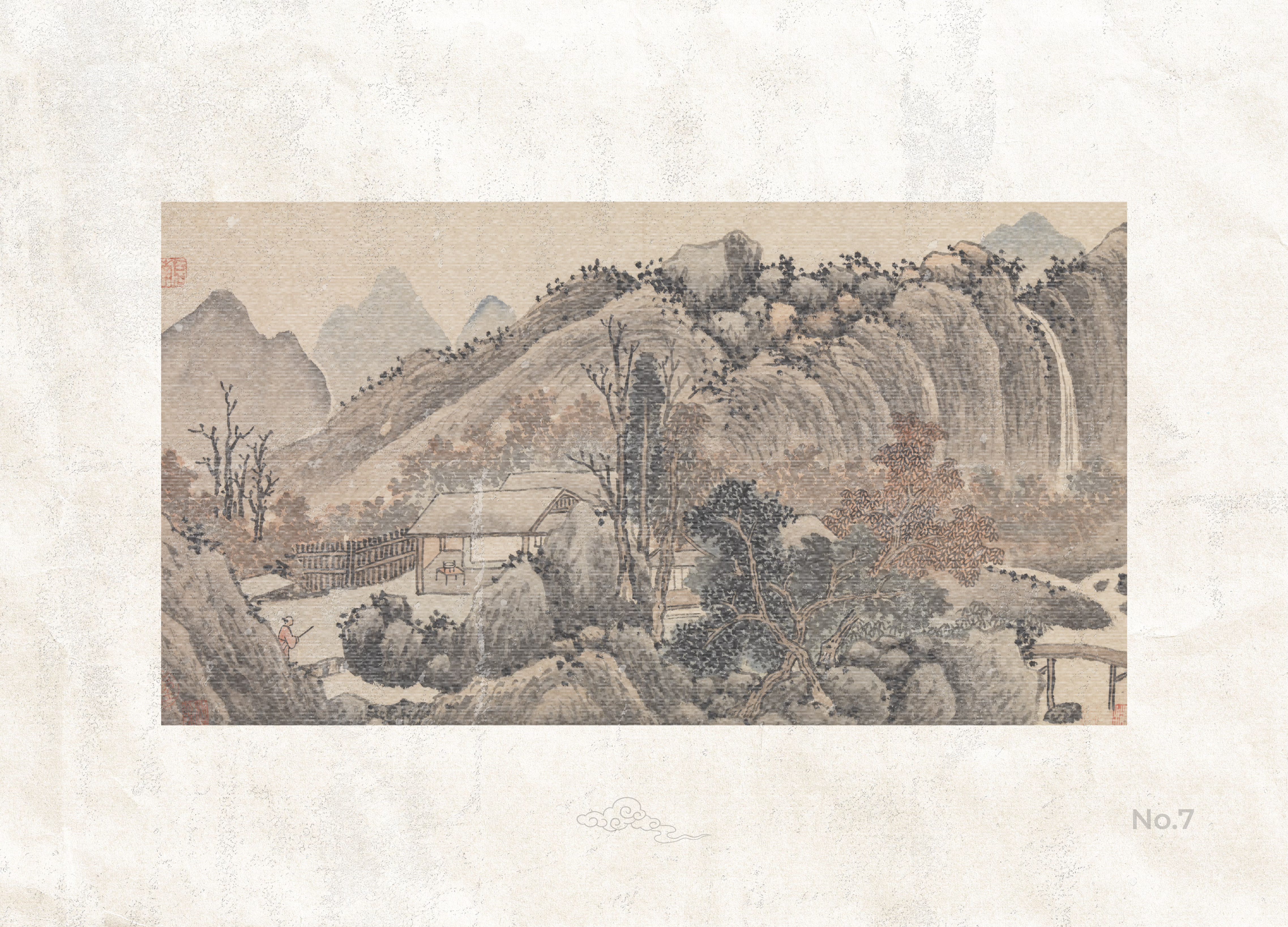
I cannot recall when I developed a liking for certain things.
I mean things that embody a mixture of flowing nature and structure.
Intuitively, I think it’s a unique and individualized experience that we find such resonance, the correspondence between inner consciousness and the presentation of external things. My senses, disposition, and the specific objects and the fluid nature of the outside are co-arising.
Moonlight is white because my eyes are clear enough to receive it. Sometimes I’m seized by shifting emotions, especially when thinking of family. I am, nevertheless, drawn to the serenity of the moment, simply dwelling on the subtle experience of communing with the moonlight and the crystal clear atmosphere.
Somehow, it feels like a mystical experience in which my thoughts, emotions, and sentiments can interact with the moon, the wonder of nature. In a brief moment, my existence has become fluid, becoming one with the myriad things under the umbrella of the moonlight.
Such resonance happens to me when I interact with an artwork. There is a general sense of awe when I look at the calligraphy work by Yan Zhenqing (709-785 A.D.) in the photo below.
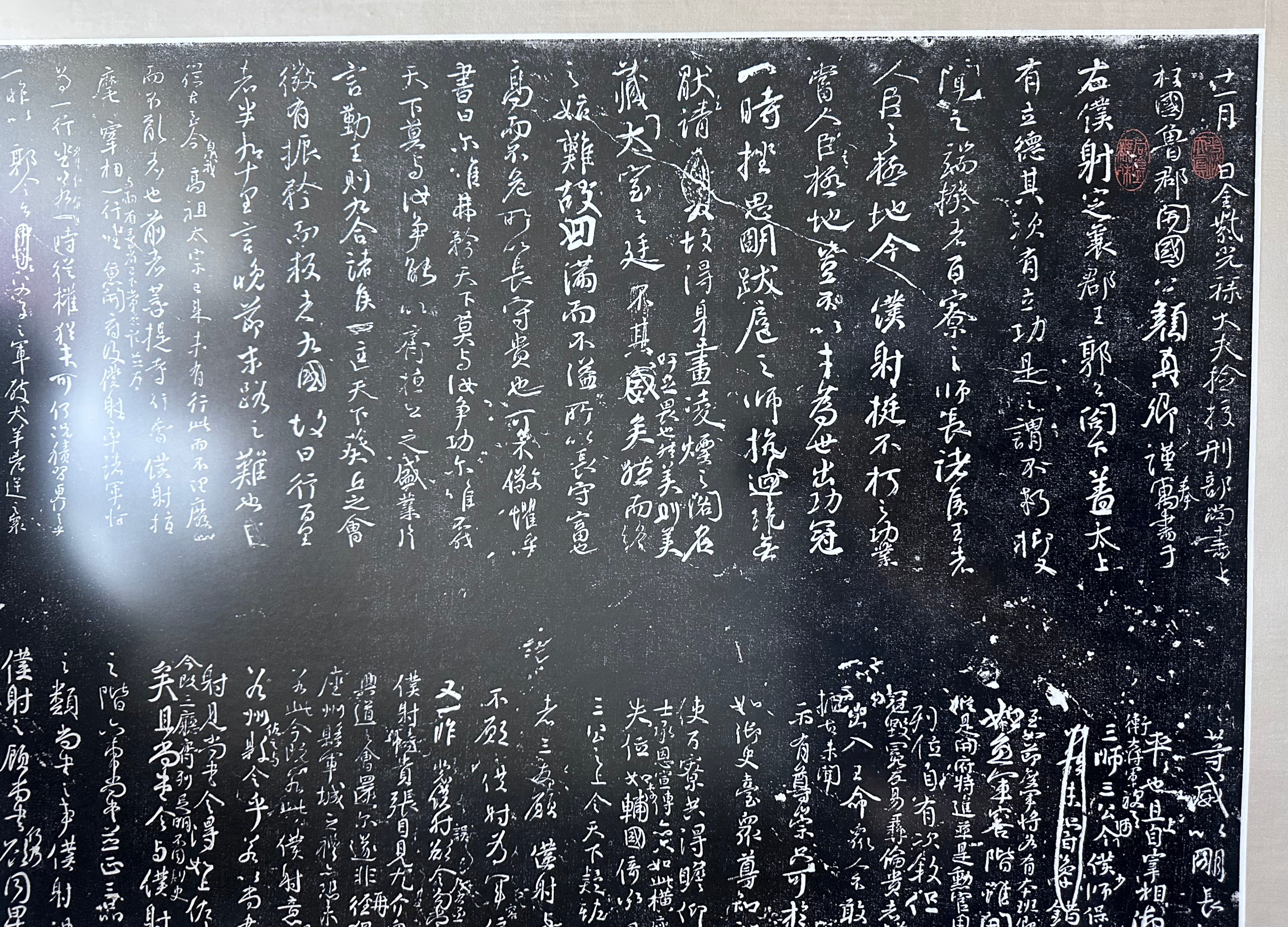
This piece was a draft letter Yan wrote to a colleague, reminding him of the seating arrangement for a political event.
Yet, it became an exemplary work, revealing flow within a natural framework. Through every character, every line, we can one step closer to his spirit, character, and skill.
I find a similar perfection of flow, symmetry, and structure in Bach’s chaconne (Partita for violin no.2). After years of keeping it a company, I’m still completely soaked in unspeakable feelings when I stay with it for a brief moment, with my spirit wandering along with the development of musical phrases.
The chaconne connects motifs that move apart and rejoin, creating dissonance, reconciliation, and inner lucidity, all of which lead to transcendence and harmony that feels inevitable.
I am amazed by the incredible, mysterious, and magical power of human creativity, the profound insights into life derived from actually going through it, naturally unfolding when connected with one’s medium of expression.
I think we all do in one way or another.
What Ziran means
Every one of us is a unique micro-universe, and we all correspond to the myriad things in various distinctive ways. There is something hidden, something unidentifiable within that drives us into the motions of life.
That human agency is invariably connected to our inborn nature and natural disposition.
Ziran, in the Taoist system, means so-of-itself. Taoists have the perception that the myriad things become what they are naturally, without the dictation of a preordained order or an external force.
To live in accordance with this innate nature, guarding it and being guided by it in the midst of living, is to be spontaneous and natural.
And to become natural is to be free, as one is living at ease with what is innately possible.
Everything that is spontaneous and natural has a mysterious kind of attraction, a silent quality that inspires, soothes, and calms.
For Chuang Tzu, ziran is a way of being, an existential alignment between one’s inborn nature and naturally flowing with the current of life.
Yet, this is not to suggest that such an alignment can be easily identified. Rather, it requires a spiritual journey of venturing into the unknown lands, an inward search that goes beyond the confines of the actual world, and breaking the barriers of one’s immediate realities.
To a large extent, it resembles the hero’s journey, and walking that path is the process of spiritual liberation.
To become awakened and liberated within, in this sense, is to redefine your own meaning of existence in the journey of self-discovery.
Going with the Tao
In Chuang Tzu’s system, Tao (dao 道) is the spontaneity of things.1 Instead of conceptualizing it as a mysterious entity, some divine existence, Chuang Tzu explains that there is no place it does not exist, or it flows everywhere in the world.2
The Tao is in the constant cycle of changing, moving, and transitioning. For the Taoists, following the Tao, therefore, means adjusting to varying circumstances, swimming with the current.
Like the wind, the clouds, and the river water, emerging, transmuting, and flowing into the unknown.
When commenting on the innate agency of the winds, as a symbol of the myriad things in nature, Guo Xiang (252-313 A.D.), a representative of the neo-Taoist philosopher during the Wei-Jin China period (220-420 A.D.), said,
That everything spontaneously becomes what it is, is called natural. Everything is as it is by nature, not made to be so.3
If things become themselves, it means they weren’t pushed and dictated by the outside. Not being made to be so reveals the quality of an internal autonomy.
For the person to embody one’s virtue4 (de 德), that is to say, in becoming spontaneous and natural, is to follow the Tao, to be the master of one’s own spiritual realm.
The Tao is a process of action and repose, the harmony of the yin and the yang. In this sense, following the Tao is to maintain a dynamic equilibrium and never go to one extreme.
The unity of the Tao and the de in a person manifests as a state of independent transformation (duhua 獨化)5. It entails leveraging inner freedom to navigate the tide of change into the unknown.
On a pragmatic level, independent transformation must be grounded in actual living —a concrete engagement with the minute details of reality —through which self-knowledge can be developed.
This is a spiritual journey of self-discovery, and it is not easy, as circumstances might be unfavorable.
In this sense, to become spontaneous and natural is both an arduous process of self-realization and returning. It requires, first of all, an understanding that personal transformation is a process of transitioning from an actuality to a possibility.6
Chuang Tzu’s spirit of interacting with the world while transcending it lies in trusting your limitless potential in self-transformation, but at the same time recognizing the limitations of convention. The conflict of these two constitutes the essence of the predicament of existence.
On the one hand, artificial forces, associated with the development of civilization, represented by various cultural ecosystems, create a ceiling and a cage for the average person. Everywhere, he or she is shackled by the control and limits of cultural systems, parochial worldviews, and conventional ways of doing things.
At the same time, the self may easily lose track of what it is that is worth pursuing in the midst of life’s entanglements. For the world is full of noise and allure that could make one deviate from the natural path.
Under such circumstances, Chuang Tzu was telling us this: You are a spiritual and limitless being, but only you can carefully preserve what is within you.
Returning to the genuine
The journey of self-discovery is also returning to your spontaneous and natural state of existence.
Return begins with subtraction—less clinging and clutching, more clarity and simplicity. It is about dissolving and forgetting the constraints of cultural and social conditioning, seeing through the limits of the ego while entangling with the conceptualizations of the phenomenal world, through which to get back to the authenticity within.
Genuineness, zhen 真, in the Taoist system, is a foundational value about human nature. Its opposite is insincerity, falseness, or arbitrariness.
The person who is inwardly genuine moves the external spiritually…The genuine is the means by which we draw upon Heaven, it is spontaneous and irreplaceable.7
What is derived from Heaven, or innately natural, is what defines the essence of being for a person.
Therefore, the journey of self-discovery involves navigating the intricacies and complexities of this world while preserving one’s authenticity.
For Chuang Tzu, the ideal of ziran, thus, is a spontaneous state of existence, a genuine way of living.
Still, ziran is very much a personal thing; that is to say, you need to awaken to see it, connect with it, and become it.
All of us are unique in terms of distinct virtues, capabilities, and possibilities. Accordingly, everyone’s journey is different.
Chuang Tzu advises,
Do not let the artificial submerge the natural. Do not for material purposes destroy your life.8
What matters the most is being true to your own natural self. Fundamentally, what is more heartbreaking and regrettable than giving up on yourself, on what you could have become?
The idea of Tao, despite being a central concept in Taoism, differs in Lao Tzu and Chuang Tzu’s systems. For the former, the Tao seems to stand as a mystical and independent entity outside the realm of being, the constitution of the myriad things in the world. In the Tao Te Ching, Lao Tzu has described the Tao as the fountainhead and source of the multiple things.
For Chuang Tzu, the Tao represents the spontaneity of things. To become spontaneous, each in their own unique ways, is the path of following the Tao. In Chuang Tzu’s depictions of various individuals, such as skilled artisans, mastery of their craft is the path to accessing the Tao. Also, the mystical experience of practicing emptying one’s heart-mind (xin 心) — seeing through one’s obsessions, conceptualizations, and the limits of ego, is also the way of becoming spontaneous and approaching the Tao.
For the Wei-Jin Taoists, Tao was generally perceived as the ontological state of nonbeing, or nothingness. This “nonbeing” is the source of being — the myriad things in the natural world, therefore, is also full of creativity and power to give. In this sense, the Taoist notion of nonbeing (wu 無) does not equal the Buddhist idea of “boundlessness,” “void,” or “emptiness” (kong 空).
Burton Watson, “Knowledge Wandered North,” in The Complete Works of Zhuangzi (New York: Columbia University Press, 2012), 182.
Fung Yu-lan, in Chuang Tzu: A New Selected Translation with an Exposition of the Philosophy of Kuo Hsiang (Beijing: Foreign Language Teaching and Research Publishing, 2016)19.
In the Taoist system, the idea of virtue, or de 德, is the actualization of the Tao in the person.
A concept from Wang Bi 王弼 (226-249 A.D.), a representative of the Wei-Jin Metaphysics 魏晉玄學 (Wei-Jin Xuanxue).
Thomé H. Fang (方東美), Chinese Philosophy: Its Spirit and Its Development (Taipei: Linking Publishing, 1981), 27-28.
A. C. Graham, “The old fisherman,” in Chuang Tzu: The Inner Chapters (London: Unwin Paperbacks, 1989), 251-252. Translation modified.
Lin Yutang, The Wisdom of Laotse (Beijing: Foreign Language Teaching and Research Publishing, 2009), 109.
Beautiful piece! Timely reminder that 'return begins with subtraction', also a key lesson in tea. Also I appreciate your footnote comparing the different lenses of Tao. You're right in noting that Chuang Tzu's system is about being in the world, rather than the often mischaracterized perception of being a recluse or stepping away.
Love how you describe your shared moments with moonlight. There's this phrase characterizing my favorite Zen temple 雲嶺上に生ずること無く、月波心に落つること有り (meaning that 落波心 can be reflected in the water if we don't cling as much).
Thank Ypu ! Insightful, magical, logical and Authentic.
Taoist art is deceptively simple at first glance yet the more you soften your gaze the more one sees. And it’s not static - very much like the flow of water.
It leaves space for Individualisation whilst holding the basic coherence and structure of form. Wave within particle - formless in form. Unravelling and Reravelling.
Beyond your impeccable article, my Being was humming in resonance with the images you shared. All of them 🍃🍃