


His name is often associated with romantic poetry. Stories about him revolved around literary talent, wine, and a Taoist-inspired freedom from social conventions.
In popular memory, an anecdote about him was repeated over time, becoming a myth in its own right.
One day, he was summoned to the imperial court. He showed up drunk, disregarding the formalities and decorum of the court, a usually unforgivable act in a time that valued rank and rituals.
More than this, he insulted Gao Lishi (684-762), a powerful eunuch, asking him, as the tale goes, to remove his shoes.
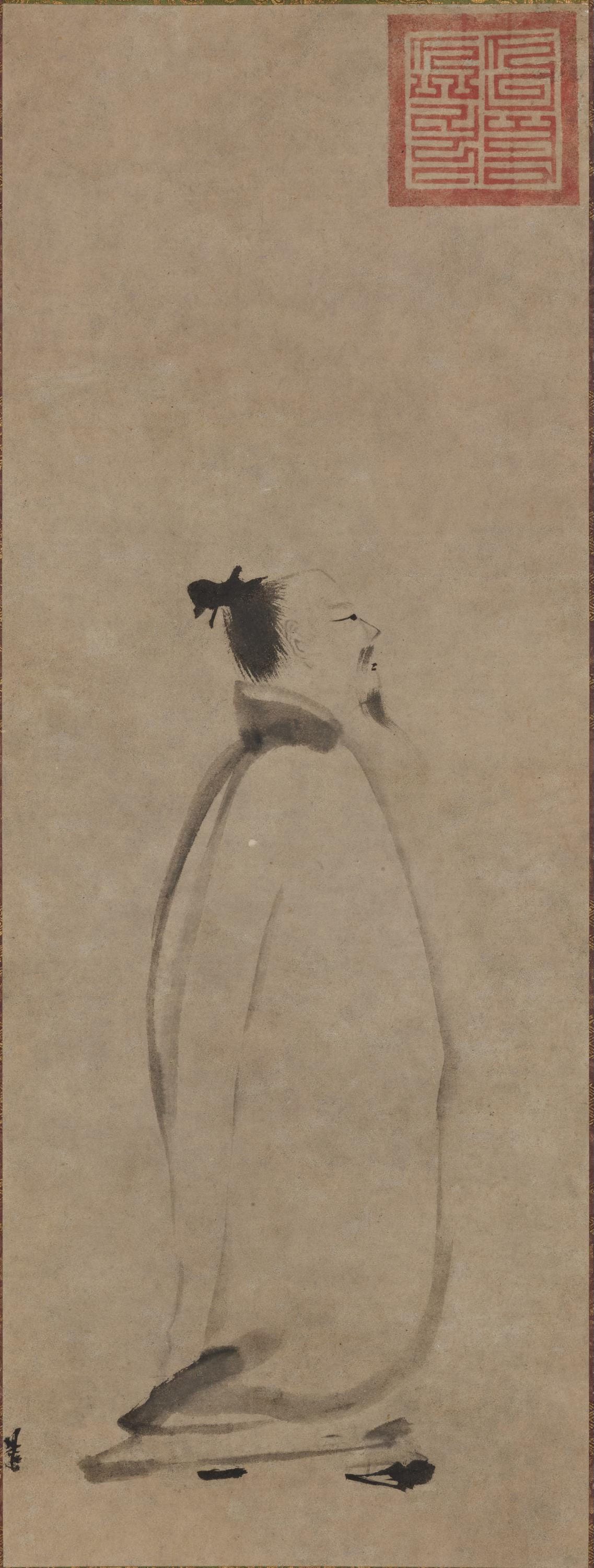
This is the famous Tang poet Li Bai 李白 (701-762), the esteemed Poet Transcendent (shixian 詩仙).
We do not know how the story ended that day.
Sometime later, the minister probably persuaded Yang Guifei (719-756), the emperor’s most favored concubine, that Li Bai’s “Qingping Melodies (Qingping diao 清平調) was not just a praise of her beauty but an insinuation — a critique of her negative influence on the emperor.
Words can cause waves in social relations. Perhaps, they travel even faster in the circles of imperial politics.
Li Bai was soon punished. Afterward, he spent much of the rest of his life wandering, with only brief political involvement intermittently.
On an experiential level, Li Bai is similar to us, experiencing the various forms of the human condition while finding our own ways to establish ourselves as we navigate the world.
From the Wei-Jin to the High Tang
The Wei-Jin era was characterized by prolonged political and social instability. Wars and conflicts recur in the realm for almost four hundred years. Amid this time of disorder, something significant was fermenting and emerging, eventually manifesting in the discovery of the self.
This inner awakening took many forms, as we see in the rise of Wei-Jin Metaphysics (Weijin xuanxue 魏晉玄學), neo-Taoism, the influx of Buddhism and its integration with the existing spiritual makeup, the reformation of poetry, artistic innovation in landscape painting, and the first climax of Chinese calligraphy.
A defining, shared thread among these forms of expression is the Wei-Jin spirit of freedom — individual sovereignty in the natural self against the restraints of rituals, represented by Ruan Ji (210-263) and Ji Kang (223-262), members of the Seven Sages of the Bamboo Grove (zhulin qixian 竹林七賢), and many outstanding individuals.
The Tang culture offers a different flavor: grandeur, imperial confidence, stability, and prosperity, substantiated by a sturdy architecture of a civilization at its peak.
But still, the human condition persists, with its problems, when an empire is flourishing. To some extent, the more complete the political order becomes, the more suffocating its demands can feel for those outside the rigid frameworks of the cultural, social, and political systems.
Regarded as the symbol of Tang romanticism, Li Bai is often read through mountains, wine, moonlight, and the unrestrained poetic language. Yet part of his appeal lies in something older — a Wei-Jin state of being, where emotions, innermost thoughts, words, and actions cannot be separated.
It is on this experiential level that Li Bai, to some extent, inherited and embodied that spirit. In his poetry, as well as his life, we see this theme again and again: that the poet’s heart could not find a proper place inside the imperial ritual order.
A young man with ambition
Li Bai was born in 701, during the reign of Emperor Xuanzong (685-762) — a period often described as the Tang dynasty’s peak.1
At about four years old, his family — originally from Longxi 隴西 (a county in today’s Gansu province), but probably lived in exile in Tiaozhi 條支, near present-day Ghazni, Afghanistan — moved back to Sichuan.
So the young Li Bai grew up in Qinglian village, today’s Jiangyou county. Later, he called himself Qinglian Jushi 青蓮居士.
Apart from his love of swordsmanship, he was heavily influenced by the Confucian ideal—the scholar-official who applies his learning and abilities to serve the state. This is a path of meaning: being useful, recognized, and carving out a place in this world for oneself.
But too many hopes can sometimes end in profound disappointment and disillusionment.
In 725, at the age of twenty-five, Li Bai left home and began his adventures in southern China.
In 727, he married into the Xu family, an influential house in Anlu, Hubei province. At this time, his literary talent has earned him some local recognition.
We can guess that he was probably searching for access, for a doorway to enter into public life. In imperial politics, personal brilliance could be admired while still remaining unusable.
Around 730, at the age of thirty, Li Bai arrived in Chang’an, hoping to connect with someone who could help him realize his political ambitions. Chang’an, at this time, was not merely a city, but a living instrument of power. For a literary person like Li Bai, his future could be decided through networks and favors as much as through personal merit.
Around this time, Wang Wei 王維 (701-761), the poet-Buddha, had already been working in the central government for some years, with experience and a taste for political banishment between his first official post at the age of twenty-one and the year 730.
Du Fu 杜甫 (712-770), the poet-sage (shisheng 詩聖), who later befriended Li Bai, was just eighteen years old, struggling to pass the state exams to enter politics.
Li Bai probably believed, or at least hoped, that perhaps he could find his way in Chang’an by excellence. The tragedy is that the world is not always easily persuaded, and talent is never enough.
With a few years of groping, by 735, at thirty-four, Li Bai was frustrated with the stalled trajectory of his career. He decided to leave the capital.
While traveling in southern China, he wrote the famous poem, “Invitation to Wine” (Jiang jin jiu 將進酒), clearly expressing his deep-seated disappointment twisted with the sense of the flashing of time:
Do you not see the Yellow River come from the sky,
Rushing into the sea and ne’er come back?
Do you not see the mirrors bright in chambers high
Grieve o’er your snow-white hair though once it was silk-black?2
In flowing waters without an end, in the silent change of hair colors, Li Bai saw the passage of time.
Yet, he did not just indulge himself in such sorrows. The Taoist spirit began to penetrate him in moments when he was pinned down by reality. The poem then switched to a higher pitch:
When hopes are won, oh! Drink your fill in high delight,
And never leave your wine-cup empty in moonlight!
Heaven has made us talents, we’re not made in vain.
A thousand gold coins spent, more will turn up again.
Wine does not indicate simple pleasure. It becomes a necessary doorway through which the poet enters and roams in the spiritual realm, released from worries and concerns, from worldly expectations.
Still, Li Bai perhaps has sensed something darker in such hours of seizing the day:
What difference will rare and costly dishes make?
I only want to get drunk and never to wake.
How many great men were forgotten through the ages?
But great drinkers are more famous than sober sages.
Jade, exquisite meals, and all the delicacies may not be precious. But is it better to get drunk than to be awake in a vulgar world?
Li Bai probably, for the first time, felt and empathized with the difficulties and pains of those poets and sages before him, not from reading history books but from his firsthand experiences.
Perhaps in such moments, he felt the rising inner twists between his ideal and the urge to transcend.
He was still optimistic at this time. At the end of the poem, he calls on his companions to keep drinking, to trade belongings for more wine, in the hope that wine would wash away endless sorrows.
From then on, wine ceased to be a simple motif but became a medium connecting words and the poet’s inner world. Through it, the spiritual lineage of the Wei-Jin culture did not fade away, but found new life, flowering in the poetry and the wandering existence of Li Bai.
Next post on Li Bai:

Qu Tuiyuan and Zhu Jincheng, eds., “Nianpu 年譜,” in Li Bai ji jiaozhu 李白集校注 (A Critical Edition of Li Bai’s Collected Works with Commentaries), vol. 2 (Shanghai: Shanghai guji chubanshe, 1980), 1743–44.
Li Bai, Selected Poems of Li Bai, trans. Xu Yuanchong (Changsha: Hunan People’s Publishing House, 2007), 81.
Thanks for the bio sketches of these marvelous poets, bearing Taoist spirit in different forms. Of the poets you featured, I find Wang Wei's quiet clarity most balanced!
From this post, I thought it's interesting you mentioned that Wei-Jin era culminated in the climax of calligraphy, where it became a vehicle for expression. In instability, creation becomes possible.
Mysticism as the thing that unthreads certainty without collapsing meaning hits. Less answers, more capacity to love what is. That feels like real faith, not the performative kind.