

#3 The Hidden Path to Harmony
Tao Te Ching, Chapter 3: Discover governing with wu-wei and non-interference.


Welcome back to The Wisdom of Lao Tzu.
This week, we’re reading Chapter 3 of the Tao Te Ching, which raises provocative questions about the nature of competition and the hidden dangers of knowledge.
Is it possible that what we strive for most in life — success, fame, and status — might actually disrupt our inner peace?
Let’s explore this intriguing paradox together.
**3**
不尚賢,使民不爭;
不貴難得之貨,使民不為盜;
不見可欲,使民心不亂。
是以聖人之治:虛其心,實其腹;弱其志,強其骨。
常使民無知無欲,使夫智者不敢為也。
為無為,則無不治。
Border-crossing: English translations
#1 Lin Yutang’s version
Exalt not the wise,
So that the people shall not scheme and contend;
Prize not rare objects,
So that the people shall not steal;
Shut out from sight the things of desire,
So that the people’s hearts shall not be disturbed.
Therefore in the government of the Sage:
He keeps empty their hearts
Makes full their bellies,
Discourages their ambitions,
Strengthens their frames;
So that the people may be innocent of knowledge and desires.
And the cunning ones shall not presume to interfere.
By action without deeds
May all live in peace.
#2 Edmund Ryden’s version
Promote not the worthy, then the people will not compete.
Esteem not objects hard to obtain, then the people will not be thieves.
Display not what is desirable, then the people’s hearts will not be turbid.
For this reason,
The government of the Sage is thus:
He empties his mind, fills his belly;
Weakens his will, strengthens his bones,
Ever making it such that the people have no knowing, no longing.
If you can make it so that the astute dare not act,
then you will discover there is nothing you cannot govern1.
#3 D. C. Lau’s version
Not to honor men of worth will keep the people from contention; not to value goods which are hard to come by will keep them from theft; not to display what is desirable will keep them from being unsettled of mind.
Therefore in governing the people, the sage empties their minds but fills their bellies, weakens their wills but strengthens their bones. He always keeps them innocent of knowledge and free from desire, and ensures that the clever never dare to act.
Do that which consists in taking no action, and order will prevail2.
Deeper dive
This chapter of the Tao Te Ching echoes the earlier discussion on the principle of “doing without taking action,” or wu-wei, a core concept in Taoism.
It suggests that true governance is not achieved through forceful intervention but through effortless alignment with the natural order, letting things unfold as they should.
Interpretations
The three English translations of this chapter offer varied interpretations of its concluding sentence:
Lin Yutang: Lin’s version translates the final line as: “By action without deeds, may all live in peace.” Lin suggests that the sage ruler governs by non-action, and in doing so, peace naturally emerges. His view reflects the Taoist belief that harmonious rule comes when leaders refrain from imposing their will on society.
Edmund Ryden: Ryden offers a different perspective with the line: “If you can make it so that the astute dare not act, you will discover there is nothing you cannot govern.” Here, the emphasis is on the ruler restraining society’s intelligent and ambitious members, ensuring that no excessive or disruptive action undermines governance.
D. C. Lau: Lau presents a more literal translation of the Chinese character "治" (meaning to govern or maintain order). His interpretation underscores the idea that lasting order is achieved by a ruler who understands the art of non-action, allowing things to flow without interference.
Advice for rulers
He Shanggong (approximately 200 BC - ?), a Taoist master and commentator, offers an insightful explanation of the chapter’s concluding advice: “Do that which consists in taking no action, and order will prevail.”
He said,
“Do not falsify and intervene, and act in accordance with the natural rhythm. (A sage ruler) should cultivate his virtue and restore a sense of security in people’s minds.”3
According to He Shanggong, the sage ruler should:
Avoid promoting the talented (to prevent excessive competition),
Refrain from valuing rare objects (to avoid inciting theft), and
Not display desirable things (to prevent disturbing the people’s minds).
This approach reflects the Taoist belief that a ruler’s ability to restrain excessive personal desires ensures peace within and throughout society.
Balancing knowledge with virtue
Lao Tzu also critiques the role of knowledge in governance.
Excessive reliance on knowledge and intelligence can lead to scheming and manipulation, which often result in the abuse of power.
In this context, the sage ruler is cautious of excessive knowledge and desires, as Lao Tzu explains that the sage “always keeps them innocent of knowledge and free from desire and ensures that the clever never dare to act.”
Wang Bi (226-249 AD. See his introduction here) had two comments on this statement,
“Preserving what is true (within the heart). Being wise means one knows the act of action.”4
The pursuit of status, wealth, and fame — driven by unchecked knowledge and desires— can lead to conflict and disorder, undermining the peace and stability that is desirable by all in a society.
While Taoism may appear to embrace anti-intellectualism, its view on knowledge is more complex.
Lao Tzu recognizes the merits of employing capable individuals in governing roles, as Confucianism would suggest. However, Taoism cautions against overstretching human potential and abusing knowledge for selfish ends.
Therefore, the key is awareness and balance: Taoists prioritize inner virtue and harmony with the natural order over excessively pursuing intellectual or material greatness.
The more we succumb to the single-minded and excessive pursuits of fame and material interests, the more disquiet, inner struggle, and chaos we bring to our lives.
A cultural note
So, many may wonder, is the Taoist script from this chapter, particularly the idea of wu-wei — to deal with practical matters by following what is natural, even applicable to real-world politics and governance?
One historical case can add a note on political Taoism's influences on a dynasty's fate.
Between 180 – 141 BC, an early period of the Han Dynasty (202 BC – 9 AD, 25–220 AD), Emperor Wen of Han implemented a set of policies that aimed to improve the lives of the ordinary people, contribute to economic recovery after years of war, and restore political stability and peace.
His policies included reducing the land tax to a ratio of “1 out of 30" of the produce and imposing austerity measures on the royal and noble families.
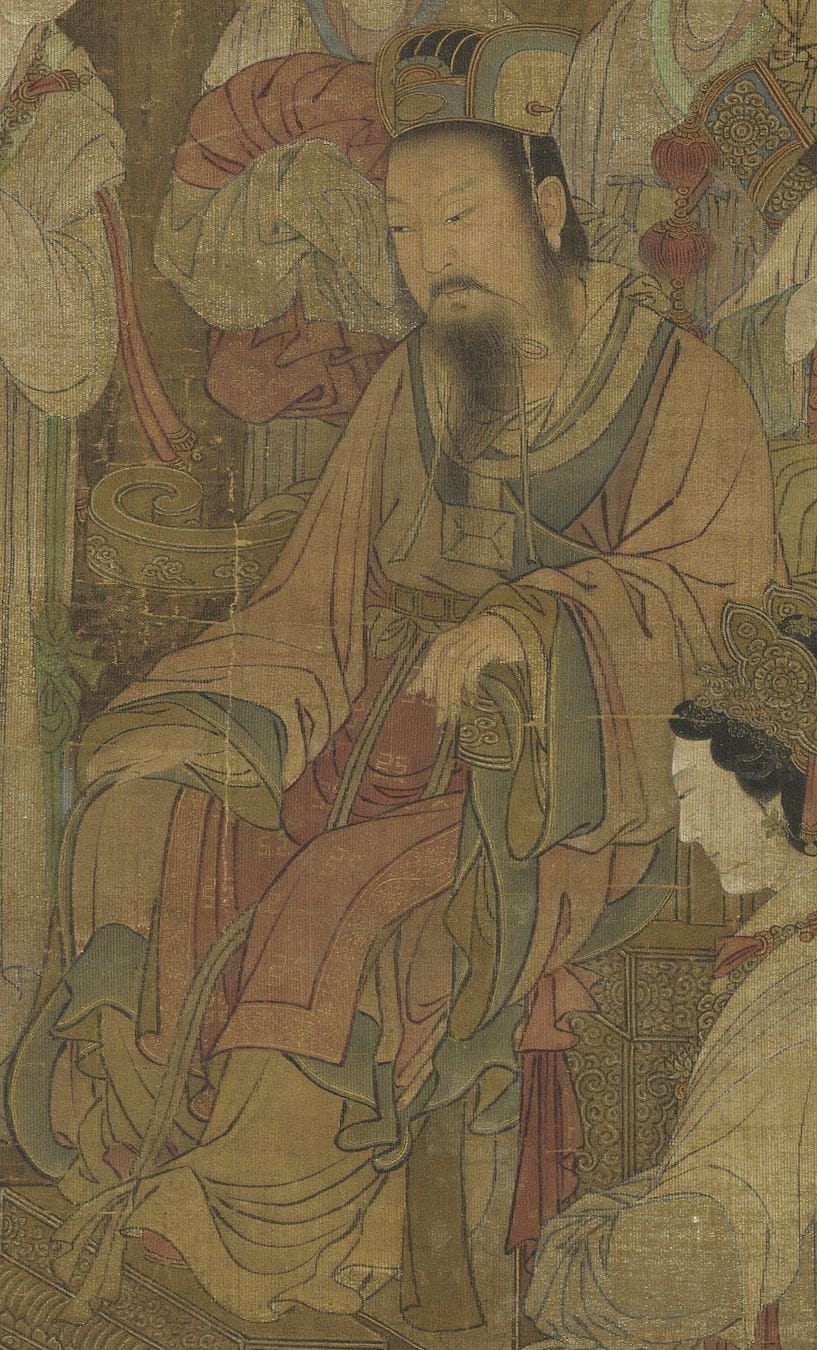
Emperor Wen of Han passed on his legacy to his son, Emperor Jing of Han, who continued to practice thriftiness and alleviate the people's burdens. It was recorded that the tax rate on personal income was around 3.3% two years after Emperor Wen of Hand died.
It turned out that Empress Dou, wife of Emperor Wen of Han, was behind “the Rule of Wen and Jing.” She was a follower of Taoist philosophy and even convinced the court to read Tao Te Ching.
It is recorded that “the Rule of Wen and Jing” is one of the golden ages of Chinese history. And Han Dynasty was known as the first great dynasty in dynastic China (221 BC- 1911).
Thanks for reading!
Wishing you peace and wisdom,
Yuxuan
Daodejing, trans. Edmund Ryden. (Oxford: Oxford University Press, 2008), 9.
Tao Te Ching, trans. D. C. Lau. (London: Penguin Classics, 1963), 7.
「不造作,動因循。」「德化厚,百姓安。」See Wang Bi et al., Four Kinds of Laotse 老子四種 (Taipei: National Taiwan University Press, 2016), 81.
「守其真也。」「智者,謂知為也。」Ibid., 3.