

The Winding Path
Part 2: On disenchantment, loss, and finding stillness in unexpected places

How do we navigate the unexpected encounters in this life?
Specifically, how do we grapple with seemingly obvious symbols of success and failure?
And in moments of crisis, when we are forced to face gains and losses, are we still able to retain inner peace and stability to adjust to our immediate realities?
Like all of us, Wang Wei experienced these turning points in both his personal and professional life. To a large extent, they reoriented his life trajectory, drawing him closer and closer to the Buddhist path.
Wang Wei was not a Buddhist practitioner in the absolute sense, yet he still managed to dedicate himself to his studies while fulfilling worldly responsibilities.
Sometimes, when I look back on missed opportunities and setbacks in my own life, I remind myself to look to Wang Wei’s example.
In some of our darkest hours, having someone guide us to see things differently, through a philosophical viewpoint, I think, can lift us, even if it may not necessarily resolve the problems at hand.
Standing with the disgraced official
In his mid-thirties, Wang Wei was at a crossroads in his public career.
The political climate in Chang’an had shifted irrevocably. The rise of Li Linfu 李林甫 as the new prime minister led to the exile of Wang Wei’s mentor and friend, Zhang Jiuling 張九齡.
Since his very first official post, Wang Wei’s career had been tossed around by the fluctuations of imperial politics (see part 1). Now, after the reshuffling in the political center, he found himself professionally isolated. In a poem to Zhang Jiuling, he wrote:
There is no one who knows me in all the age; 舉世無相識
To the end of my life, I think of your old favors.1 終身思舊恩
From hindsight, this was an unwise gesture in the eyes of many. In the pragmatic, often ruthless world of Tang politics, associating oneself with a disgraced official was an undeniable risk. Yet, Wang Wei chose to stand with his mentor, sticking to what he considered the right thing to do, no matter the consequences. |
He had just lost his wife and child a few years earlier. Now he had to face a new turning point in his career head-on.
He was dispatched on a tour to the frontier at Liangzhou 涼州 (in today’s Gansu Province). There, at the far edge of the empire, in the next few years, Wang Wei gained a clearer view of Tang politics through firsthand experience.
Being far from the capital also opened Wang Wei to a wider face of nature, beyond the familiar mountains and rivers:
From the great desert a lone line of smoke rises straight; 大漠孤煙直
By the long river the setting sun is round.2 長河落日圓
Nature, with its unspeakable power, has a way of refreshing the poet’s wearied spirit.
A question put to Shenhui
Releasing oneself from what is familiar can open the door to unexpected discoveries.
Yet we tend to be misled by the habit of dualistic thinking, either grasping what is already gone or longing for imagined alternatives. In doing so, the spirit is always on the outside, chasing and seeking, and hence, disturbed.
During these years of work and travel, Wang Wei made another crucial encounter. In the 740s, he attended a debate between the Northern and Southern schools of Ch’an. The leader of the Southern School was Shenhui (神會, 670–762), a disciple of Huineng (惠能, 638–713), the founder of the school.
While listening to the debate, Wang Wei posed a question: “How about liberating oneself through self-cultivation?”
Shenhui replied: “Every person has a pure heart-mind (zhongsheng ben zi xinjing 眾生本自心淨). Assuming that you want to cultivate your heart-mind, this is basically letting it be misguided, not the path toward liberation.”3
Both were struck by each other’s thoughts. Shenhui later invited Wang Wei to compose a biography of his master Huineng, which was inscribed on a stele.
Wang Wei grew up with the influence of the Northern School, which emphasizes sitting meditation (zuochan 坐禪) and continuous cultivation.
The Southern School, by contrast, insists that every individual already possesses a pure mind within and that enlightenment means seeing one’s pure nature directly and instantaneously, not gradually. In other words, one either sees it immediately or not.
Judging from Wang Wei’s existing works, we can actually see the influence of both schools.
Learning to say farewell
Bidding farewell, however, was a lesson Wang Wei was forced to learn again and again.
Around 740, he lost his mentor Zhang. In the same year, while on court duty in Xiangyang 襄陽, he expected to see his old friend, the poet Meng Haoran 孟浩然 (ca. 689–740), only to find that Meng had already passed away. Saddened, he wrote:
I can no longer see an old friend. 故人不可見
Han River waters flow eastward daily.4 漢水日東流
We can only imagine what Wang Wei might have felt during that visit, thinking, perhaps, about the shortness of this life, so inconstant, so ungraspable.
These successive losses subtly reinforced a deepening Buddhist sense of impermanence. When he finally returned to Chang’an in his early forties, Wang Wei began to develop a way of life that allowed him to fulfill worldly duties while becoming more and more of a lay Buddhist disciple, just like Vimalakirti:
…In his later years, he became a vegetarian and often dressed plainly… While in the capital, he offered meals to over ten famous Buddhist monks every day and enjoyed discussions with them on philosophical issues. He had nothing in his room but a tea set, a mortar of Chinese medicine, a desk for sutra-reading, and a rope-made bed. After coming home from the court, he spent his time sitting in meditation and chanting sutras with burning incense.5
What changed was not merely outward appearances. His poems from this period began to show fewer color words, the palette, like the poet himself, growing quieter and even more restrained.
We see that Wang Wei’s understanding of Buddhism gradually shifted from consciously studying its teachings to internalizing them, with traces of the self being drawn out from sensory experiences interacting with the phenomenal world. This change became evident in everything he wrote afterward.
Night meditations in the forest
It was during this period that Wang Wei began his “half-official, half-hermit” existence, dividing his time between court duties and his estate at Wangchuan 輞川, a mountainous region near the capital.
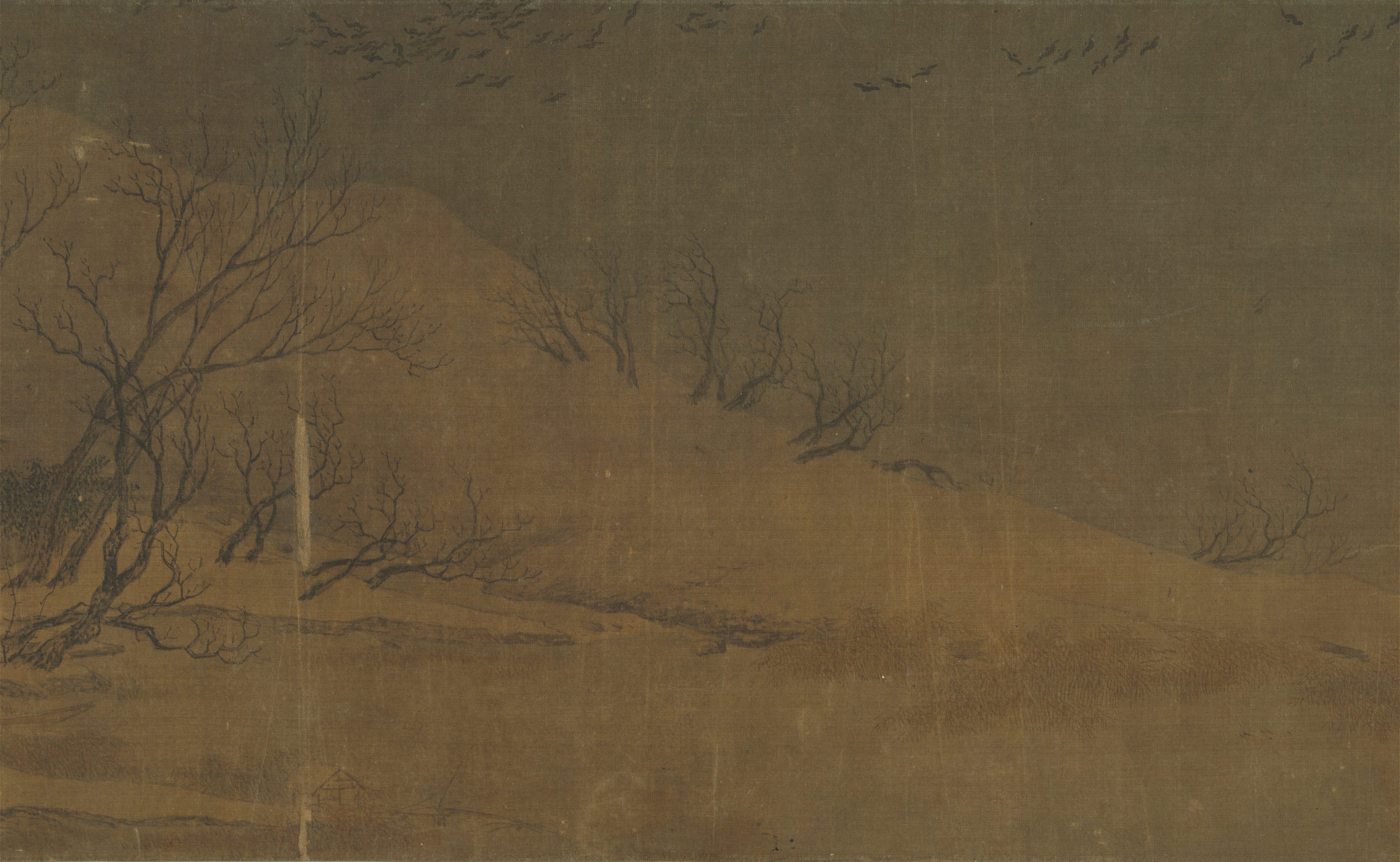
In the memory of later generations, Wangchuan has become a symbol of poetic landscapes and harmony with nature. It was recorded that he painted the place, but the original copy has been lost. There, Wang Wei could finally find a retreat after worldly entanglements.
Between engagement and withdrawal, a third way of living arises: a non-dual attitude toward things. Wang Wei could convince himself that worldly fame should rest only on “tassels and girdles”: the formalities of public service, while the heart and spirit find peace in the pure teachings of Buddhism.
A key tenet of Mahayana Buddhism, embodied in Ch’an, is the practice of non-grasping and non-dwelling: the heart-mind does not cling to the past, the present, or the future. It sees into the ultimate reality, the shifting moves of all things, like seeing the stars and the moon taking on evanescent forms, yet still everlasting. In other words, it is to remain in a state of open, intuitive awareness, knowing how one interacts with external circumstances in the very moment of contact.
Mountains and rivers became close companions, healing the poet with their unfathomable wonder. He would often wander without a particular purpose, simply observing, and perhaps, encountering the feeling of becoming one with the spontaneous rhythms of nature:
Along the mountains for a myriad turns, 隨山將萬轉
Yet traveling no more than a hundred miles. 趣途無百里
Noises deafen amid a jumble of rocks, 聲喧亂石中
And colors are tranquil deep within the pines. 色靜深松裏
Tossing lightly, water chestnuts float; 漾漾汎菱荇
Clear and still, reeds and rushes gleam. 澄澄映葭葦
My heart has always been serene: 我心素已閒
The clear river is equally at peace.6 清川澹如此
…
Court duties, for Wang Wei, became simply part of living. It exists not as an alternative, not something to be negated or escaped. In the non-dual view, the distinction between “good” and “bad,” between samsara and liberation, is already a conceptual perception of reality. Fleeing one end or seeking the other is itself a form of suffering.
Yet in nature, embodying the non-differentiation state of Tao and the ultimate reality of emptiness, strained emotions find release, and the spirit is soothed.
Sometimes, a thought would carry Wang Wei out to explore what the surrounding landscape might offer:7
In the setting sun, mountains and waters were lovely. 落日山水好
The tossing boat trusted the home-blowing wind. 漾舟信歸風
Enjoying the strangeness, unaware of distance, 玩奇不覺遠
I followed all the way to the source of the spring. 因以緣源窮
…
Old monks — four or five men, 老僧四五人
At leisure in the shade of pines and cypress. 逍遙蔭松柏
At morning chants the forest has not yet dawned 朝梵林未曙
During night meditation, mountains are even stiller. 夜禪山更寂
…
The valley stream’s fragrance pervades men’s clothes, 澗芳襲人衣
The mountain moon illumines the stone walls. 山月映石壁
In such moments of peaceful wandering, the poet regains his serenity through being with the rhythm of nature itself.
The mountain moon, the valley stream’s fragrance, the monks and poet at those hours of stillness, become harmonized, unified in a state of oneness.
This is the spirit liberated through tathata (rulai 如來), or suchness. It signals a state of mind that does not try to define or conceptualize external reality, but sees reality as it is.
What more should one ask or seek, if such inner peace is already possible?
Approaching the end of the poem, Wang Wei wrote: “seeking again I fear I’d lose the way, tomorrow I will go out to continue my climbs.”
Life continues, and we may be struck by external waves again and again. But we already carry the innate capacity to reposition ourselves in its current.
Part 1 can be found here:
Ch’an Buddhism in Wang Wei’s Poetics

Ch’an 禪, or Zen, is fundamentally a way of being, a life attitude untethered from rigid purposes and calculated plans.
The next part will be focused on Wang Wei’s life at Wangchuan 輞川 and the Ch’an poetry he was often known for.
Wang Wei, The Poetry and Prose of Wang Wei, vol. 1, trans. Paul Rouzer (Boston: Walter de Gruyter, 2020), 248-249. The title of this poem is “Sent to Zhang of Jingzhou, the head of the Department of State Affairs 寄荊州張丞相.”
Ibid., 325-326. The poem is titled “Sent to the frontier on a mission 使至塞上.”
Yang Zengwen, ed. Shenhui heshang chanhualu 神會和尚禪話錄 [Record of the Chan Buddhist Talks of Master Shenhui] (Beijing: Zhonghua shuju, 1996), 85.
Wang Wei, The Poetry and Prose of Wang Wei, vol. 2, trans. Paul Rouzer (Boston: Walter de Gruyter, 2020), 136-137. The poem is titled “Lament for Meng Haorao 哭孟浩然.”
Liu Xu et al., eds., Jiu Tang Shu 舊唐書 [Old History of the Tang] (Beijing: Zhonghua shuju, 1975), 5052.
Pauline Yu, The Poetry of Wang Wei (Bloomington: Indiana University Press, 1980), 190. This poem is titled “Green Creek 青溪.”
Ibid., 144. This poem is another classic of Wang Wei’s poems with a mixed theme of Buddhism and nature, titled “Stone Gate Monastery on Mt. Lantian 藍田山石門精舍.” Lantian was the place where Wang Wei’s home was located. Today, it is a county under the jurisdiction of Xi’an.
Thank you, Yuxuan Francis Liu. This will not be the last time I read this story. It is too familiar.
"Wang Wei wrote: “seeking again I fear I’d lose the way, tomorrow I will go out to continue my climbs.”
Life continues, and we may be struck by external waves again and again. But we already carry the innate capacity to reposition ourselves in its current."
I suppose any who seek will lose their way, but with a measure of hope at night, tomorrow will arise wholesome states all can happily live with.
This writing form feels strangely like a painting. Thank you.