


Mountain hiking is often arduous, yet joyful, especially when shared with a few kindred spirits. Sometimes it is a solo journey, if the climber is experienced and well-prepared.
That’s how we assume it to be.
Xie Lingyun’s hiking was different.
Stories were told about his adventurous, often reckless behavior in the deep mountains.
One day, a local magistrate named Wang Xiu 王琇, after receiving a report, saw a vast procession carving through the mountainside.1
Alarmed, the magistrate mistook it for a band of mountain brigands (shanzei 山賊). He then set the city under emergency alert.
Only later did he realize it was Xie Lingyun’s party.
To open new hiking routes, Xie Lingyun would often cut paths through dense forests with a few hundred attendants.
This became one of the defining images attached to his name.
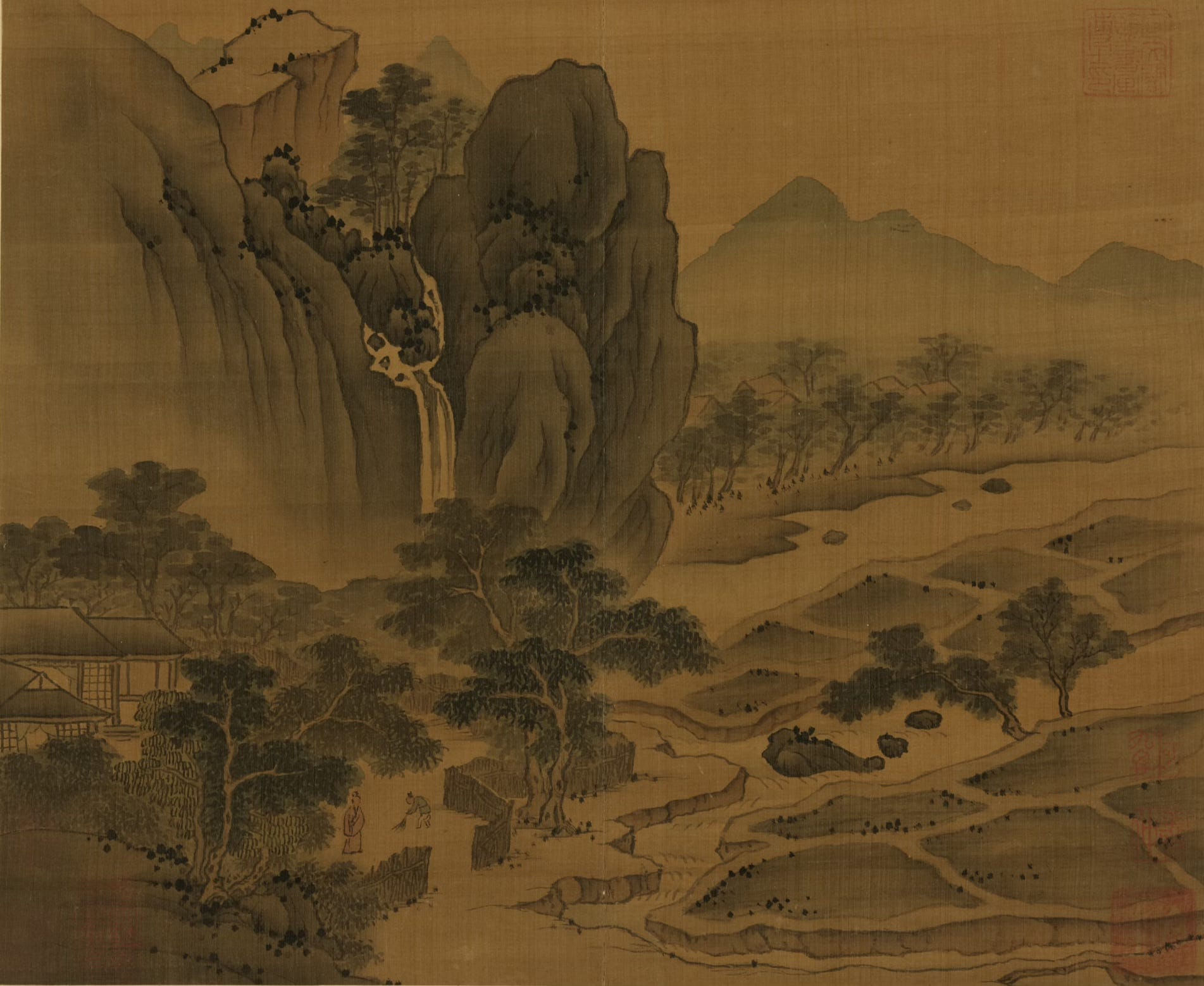
Mountain dwelling amidst political failures
Being dispatched to Yongjia in 422, Xie Lingyun tasted his first major political setback (see part two). The official term was three years, yet he resigned after only one year in the post.
Lingyun could do so because he was not bound by any material constraints. He then moved back to his family estate at Shining 始寧, withdrawing once more from public life.
Back at Shining, he now had time to explore the coastal mountains and ravines of the region. And the “mountain brigand” style of climbing emerged during this period.
Yet his withdrawal was not really quiet, as his poems and eccentric behavior circulated back to the court.
By 426, with political changes settled in the capital, the new emperor summoned Xie Lingyun. This year, he turned forty-two.
He probably thought that his time had finally come: to make some political contribution with his passion, training, and experience. Yet he was appointed as the director of the Imperial Library (mishu jian 祕書監), with the main responsibility of helping compile and write the history of the Jin Dynasty.2
This was, on paper, a prestigious post: stable, respected, and significant.
But it was everything Xie Lingyun did not care for.
He knew that the dynasty was still under threat from the north. And he certainly remembered his family’s glory in defending the realm when the northern army attempted to invade a few decades ago.
In a poem attributed to his grandfather Xie Xuan 謝玄 (see part one), he captured the mood of the age:
The heartland once sank into turmoil (中原昔喪亂)
And how could that turmoil ever truly end (喪亂豈解已)3
Wang Xizhi 王羲之 (303-361), the renowned calligrapher from the Eastern Jin Dynasty 東晉 (317-420), once lamented that his ancestors’ tombs were destroyed in the north in a draft letter, resonating with Xie Lingyun’s own reflections.
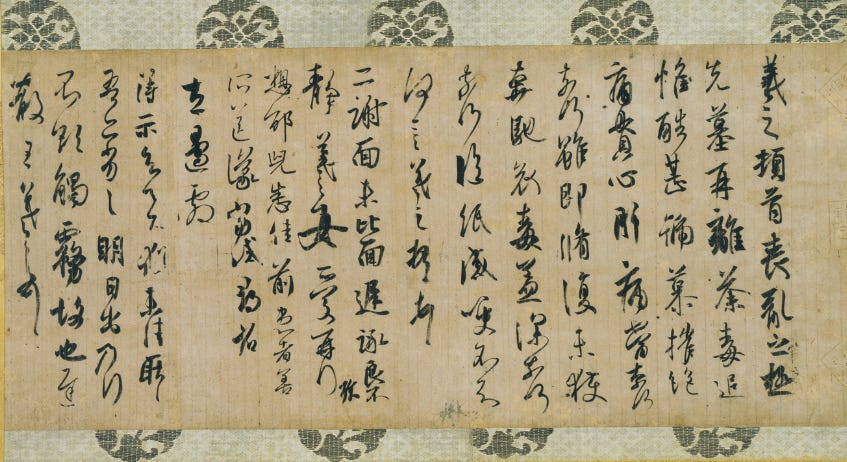
This overwhelming sentiment has, throughout history, reverberated in the Southern Song Dynasty 南宋 (1127-1279) and, after 1949, when the Republic of China (ROC) government retreated to Taiwan, it continued to echo.
In 428, Xie Lingyun resigned from his post, leaving the emperor with a letter and his thoughts on national defense and northern expedition.
Writing the mountains into poetry
Once more, Xie Lingyun returned home at Shining, this time without official duties or political expectations.
And this period marked the most productive and distinctive phase of his poetic creation. The majority of his mountain-and-river poems (shanshuishi 山水詩), the works that would later define his genre, were awaiting him.
In his poems, we would see again and again how he interacted with nature scenes in movement, wandering and meandering, climbing, overlooking the sea, losing the path, pausing, and looking back.
Landscape witnessed by foot
One of his most beloved destinations lay southwest of his Shining estate: Stone-gate mountain (shimen shan 石門山), a narrow mountain pass.
In his travel notes, he described the route in detail:
At Shimen are six ravines. Going upstream, one enters between two mountain mouths. Rock walls rise on both sides; on the right, a stone cliff; below, the waters of the ravine.”4
He frequented this place, and the poem moves like the hike itself:
I started thinking of impossible cliffs at dawn
and by evening was settled on a mountain-top,

scarcely a peak high enough to face this hut
looking out on mountains veined with streams,

forests stretching away beyond its open gate,
a tumble of talus boulders ending at the stairs.

Mountains crowd around, blocking out roads,
and trails wander bamboo confusions, leaving

guests to stray on clever new paths coming up
or doubt old ways leading people back home.

David Hinton, trans., The Mountain Poems of Hsieh Ling-yun (New York: New Directions Books, 2001), 56.
Cliffs, ridges, deep, dense forests, and winding paths can feel intimidating. Yet Xie Lingyun enjoyed such wilderness touring, despite the physical challenges:
Climbing perilous paths, I build a dwelling in seclusion
Parting the clouds, I lie beside the Stone Gate.
Moss so slick, who could tread upon it?
Vines so frail, how could one grasp them?5
Overcoming the small difficulties — the slippery moss, the fragile vines, he could see rare scenes unknown to the many:
Bending down, I rinse in the pool beneath the rocks
Looking up, I watch the gibbons in the branches.
In the morning I can hear the evening winds rise swift
At dusk I see the morning sun glow.
The leaning cliffs let light linger only briefly
In the deep forest, echoes rush and scatter with ease.6
In this unmanned mountain corner, he saw the clear pool beneath the rocks and gibbons moving among trees. And the sense of time seemed to be blurred by the intersection of evening winds and morning sun.
Suddenly, he realized that light could not linger too long on the leaning cliffs, and sounds were anxious to race through the remote forests.
Throughout these journeys, solitude remained his constant companion. Dwelling on the mountain top, he lamented: “in this regret no one here’s kindred enough to climb this ladder of azure clouds with me (惜無同懷客 共登青雲梯).”7
Seeing nature unfold in time
At the same time, he was also crafting travel poetry. To some extent, mountain dwelling and walking became a way of being. In these travel poems, landscape is barely a static object. It is something experienced through motion, angle, light and shadow, colors, and sound.
In a poem titled “Crossing the lake from south mountain to north mountain,” he described the changing views from a boat:
Where the pitched trail enters recluse depths
Above ringed dragon-jade isles all ashimmer,
I see treetops tangling away into sky below,
Hear rivers above flooding the Great Valley.
Streams branch past rocks and flow away.
Forest paths are grown over, tracks gone.8
The curved islands in the flowing river, the side path, and the roaring ravines — the wonders of nature — walked into Xie Lingyun’s poetic mind in moments of quiet observation.
And he absorbed the smallest details of mountains with care. In another poem titled “Following axe-bamboo stream, I cross over a ridge and hike on along the river,” he experienced nature unfolding in time:
Though the cry of gibbons means sunrise,
Its radiance hasn’t touched this valley all
Quiet mystery. Clouds gather below cliffs,
And there’s still dew glistening on blossoms9
In these carefree moments, the poet seemed to have merged with nature:
Reaching tiptoe to ladle sips from waterfalls
And picking still unfurled leaves in forests,
I can almost see that lovely mountain spirit
In a robe of fig leaves and sash of wisteria.
Perhaps in these brief, simple, and tranquil moments of being with nature, his heart was purified and released from the aspirations, anxieties, and terrors of the political world.
By this point in his life, Xie Lingyun had failed repeatedly in politics. Despite his talent, his somewhat self-willed, excessive temperament made him political enemies easily.
In politics, he could not accomplish as much as he expected.
Yet, in the poetic world, he fulfilled his own wish — “To the end of mountains and seas I’m going, farewell, my friends! (jiangqiong shanhaiji yongjue shangxin wu 將窮山海跡 永絕賞心晤!).”10 — establishing the mountain-and-river poetry that would reshape the entire Chinese poetic tradition for centuries.
Next on Xie Lingyun:

Shen Yue, Book of Song 宋書, vol. 6, “Biography of Xie Lingyun 謝靈運傳” (Beijing: Zhonghua Book Company, 2018), 1942.
Ibid., 1938.
Shaobo Gu, ed. and annot., Xie Lingyun ji jiaozhu 謝靈運集校注 (Zhengzhou: Zhongzhou guji chubanshe, 1987), 104.
“Travels among famous mountains (you mingshan zhi 遊名山志), in Xie Lingyun ji jiaozhu 謝靈運集校注, 276-277.
The original Chinese reads: 躋險築幽居,披雲臥石門。苔滑誰能步,葛弱豈可捫。 Xie Lingyun ji jiaozhu, 174.
「俯濯石下潭,仰看條上猿。早聞夕飈急,晚見朝日暾。崖傾光難留,林深響易奔。」
David Hinton, trans., The Mountain Poems of Hsieh Ling-yun (New York: New Directions Books, 2001),
Ibid., 58.
Ibid., 59.
Xie Lingyun ji jiaozhu 謝靈運集校注, 35.
I enjoyed this very much! Thanks for layering the introductions of Xie Lingyun with much dynamism. A key takeaway for me: “Landscape is barely a static object. It is something experienced through motion, angle, light and shadow, colors, and sound.”
I get this guy :) I spent much time machete-ing paths in the forests mountain and sitting by many rivers. what a great teacher.