

War, stillness, and the individual
Taoist strategies for navigating instability and uncertainty.

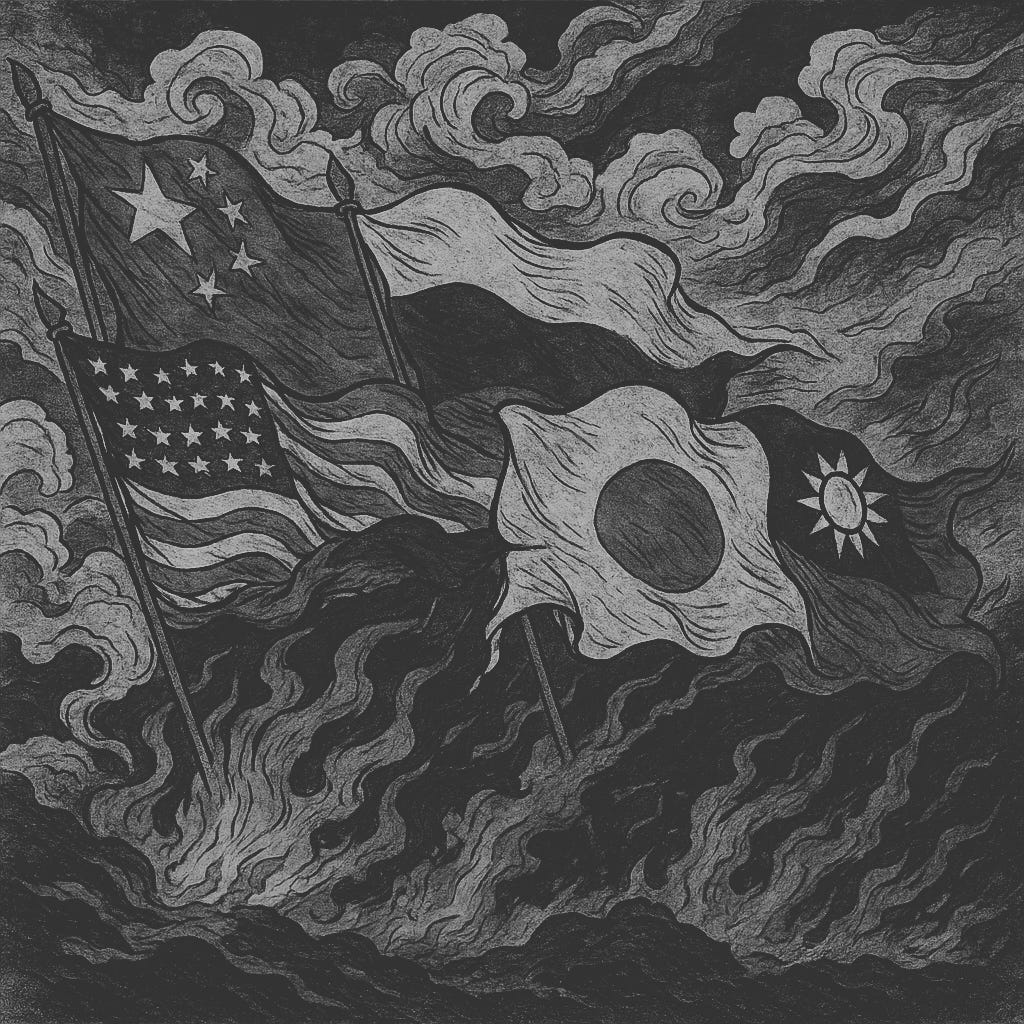
Arms are the instruments of evil.

夫兵者,不祥之器也。

Tao Te Ching, Chapter 31
The specter of war is haunting the world today. After three years of the Russia-Ukraine war, Europe has awakened from the dream of peace and stability. Even after the war closes in the foreseeable future, the political landscape in Europe and the Eurasian landmass is set to change.
The same can be said of the general attitude of the Europeans toward Russia. Will they trust their neighbor? Is it possible to trade with and do business with the country?
It all comes down to the question: Can we go back to the way things were? Specifically, is it politically feasible to imagine a stable, predictable, and progressive Russia peacefully living with its neighbors, just as it was in the old days of globalization?
To some extent, Russia’s integration into the global capitalist order after the end of the Cold War was an act of conforming to practical necessity — to make friends with the West and therefore usher in economic reform and political liberalization (perestroika and glasnost).
On the other hand, Russia’s transition from a communist state to a cooperative player in the international system can also work as a successful case for the practitioners of modernization theory.
Right after the breakdown of the Berlin Wall, the ideal of liberal democracy was running supreme. It was hailed as the winning model for governance in a modern state. Throughout the 1990s, the promotion of democracy on a global level was a signature policy of the Clinton administration.
Therefore, everything seemed to work on the surface. Russia was playing by the rules of the game, becoming a member of the Group of Eight (G8) until 2014. So, everyone thought the democratic transition had consolidated in the country. Peace and stability prevailed. How good it is for the liberal international order!
In the Far East, the People’s Republic of China (PRC) was also gradually catching up with the currents of globalization. The Communist regime in Beijing, after the Tiananmen Massacre in 1989 and the embargo from the US-led West, was quickly adapting to manage domestic and external challenges better. Regime survival and resilience were all that mattered to the Leninist party, and it played the game with patience and pragmatism.
As the playbook of modernization theory prescribes, if Communist China could follow the path of economic development and integration into the global system, eventually leading to political liberalization, a new political, economic, and social ecosystem would arise in East Asia. And that’s good news for the region and the US-led international order.
All will be good if the trends were to follow along with policy design (or, to some extent, wishful thinking?).
Social and political circumstances on a global scale are always changing. This means that some elements of political strategies and policy plans are destined to fail, as new conditions always demand proper and innovative solutions.
Therefore, today, we are seeing the recurring airstrikes, bombing, and killing in the Middle East, North Korea taking no breaks in testing its missiles and playing fire with its nuclear program, while joining Russia’s war in exchange for critical technology transfers (will they get it from the Kremlin?), a prolonged territorial disputes among China, Japan, the Philippines in the South China Sea, and the ever-more intense tension in the Taiwan Strait.
It’s challenging to predict how geopolitical tensions in various regions, economic decoupling between the US and China, and technological disruptions will affect the normal pace of life. But something darker is encroaching. There is no place for safety and security.
Of course, these observations are based on what has already happened. Whether sanity, common sense, and reason will prevail to stop the madness of destruction, unnecessary killing, and wars is still up in the air.
Despite the emergence of various crises, outcries over economic recession, and unpredictable black swan incidents that shape the course of global politics and businesses, something remains unchanged: the inherent patterns of human actions.
In this sense, war and conflict are embedded in the social fabric of our collective human civilization. The DNA components of aggression, animal passions, and desires can only be tamed and channeled by structures, codes of conduct, norms, etiquette, and systemic control instead of being completely eliminated.
Realizing this fact, I think the following conversation between a recluse and a ruler, recorded in the book of Chuang Tzu, is still penetrating and sharp in understanding political decisions.
Good intentions
A recluse named Xu Wugui was visiting the state of Wei, and got to meet Marquis Wu.1
Intrigued by the purpose of this uninvited visit, Marquis Wu said, “I have been hoping to see you for a long time, sir. I would like to cherish my people, practice righteousness, and lay down the weapons of war, how would that do?”
Xu Wugui said, “As the sole ruler of this land of ten thousand chariots, you can tax the resources of the entire populace of your realm to satisfy your appetite. The spirit loves harmony and hates licentiousness. Licentiousness is a kind of sickness, and that is why I have come to offer my advice. I just wonder, my lord, how aware you are of your own sickness.
Your intention, to cherish the people is to open the way to harming them! To practice righteousness and lay down your weapons is to sow the seeds for more weapon-wielding!
You may think you are practicing benevolence and righteousness, but in effect you will be creating a kind of artificiality…. If you kill the officials and people of another ruler and annex his lands, using them to nourish your personal desires and your spirit, then I cannot say which contender is the better fighter and to which the real victory belongs!
The system of control vs. the fate of the individual
It’s no surprise that successful leaders of all ages understand the secret of influence—winning the hearts and minds of their supporters by giving them something to believe in.
People need a symbol, a cause, a meaning, or a sense of belonging to feel understood. Hence, they feel safe and assured while going about their lives. Even though this is just a tiny part of their everyday life, having a spiritual anchor gives people a touch with earth-bound reality and somewhere to retreat when the reality becomes too harsh.
All effective collective actions are essentially based on and empowered by the unity of spirit and conviction in a particular cause, especially when the cost of action is easily perceived to be much lower than apathy and inaction. It’s never about being right or wrong, and fundamentally, it’s about whether or not the masses decide to buy the sense of meaning being presented to them.
In this sense, Marquis Wu’s motivation is clear — he is very aware of the fact that he is in charge of the system of control while also being careful of the consequences of his impulsive actions. “Cherish my people, practice righteousness, and lay down the weapons of war.” How noble and beautiful are these words!
Aren’t the authoritarian and megalomaniac leaders of our time, the Stalins, Hitlers, and Maos of the 20th century, the likes of which have followed similar scripts for political engineering?
What is in common about their political formula is that they offer people ideologies (beliefs and meanings) while intimidating (executed with subtlety) them with sheer force and violence (making sure that they know their inferior position).
As a result, the smart, obedient, and sophisticated people would certainly conform (accept being co-opted) to pressures from the political establishment. Isn’t it obvious that the so-called public sentiment and emotions are simply manufactured, to some extent, like an artificial dam through which the floods can be switched on and off with the most experienced operator (the mastermind behind political propaganda)?
It all comes down to this inevitable confrontation: the formidable system of control and the vulnerable individual.
Without a doubt, the system has the power. It designs and implements the rules of the game, while the awards and punishment mechanisms ensure the voices of dissonance are filtered and eliminated.
Given these circumstances, what is the reasonable and pragmatic choice for the individual? Is it possible to have a grasp of the circumstances while not necessarily bending one’s will to its fluctuations?
This indicates seizing one’s own fate with intelligence, not mindless exertion, not wishful thinking, not depending on fixed judgment and emotional attachments.
The strategic aspect of Taoism talks about taking life into one’s own hands regardless of circumstances. It involves avoiding personal danger, navigating complex and precarious situations, and finding an environment for self-preservation and self-transformation. All this means having a sober understanding of one’s own individual sovereignty and responsibilities.
What we can learn from Lao Tzu
A political order should serve the people, not the other way around. Isn’t this the political ideal imagined by liberal democracies — that power is constrained, leaders are accountable, and individuals are protected?
It’s not hard to find that, even in these systems, those who possess the use of force may not always practice discretion. Power attracts the arrogant, the short-sighted, and the impulsive.
All this means that we should not entertain the thought that protection and safety will always be there. Instead, we should be prepared, no matter what kind of social and political circumstances we are positioned in, for a crisis does not come to us suddenly.
1) Dealing with the sense of powerlessness
Quite often, we feel overwhelmed by fear and anxiety such that we become confused about what to do and what not to do in the face of imminent danger and threat. Yet, Lao Tzu teaches us that even the weakest, the most powerless, has a source of inner strength — compassion.
I have three treasures
Which I hold and cherish.
The first is known as compassion…
Being compassionate one could afford to be courageous,
Through compassion, one will triumph in attack and be impregnable in defense.
What heaven succours it protects with the gift of compassion.2
Compassion is not softness. It inspires clarity of heart in desperate moments and becomes the fuel of lasting courage.
You will find that, without exertion, strength will come to you from within. There’s no need to match the enemy in brutality. And you can remain unyielding in the face of distortion.
2) You are the sole protector of your own sovereignty
Fundamentally, you are the guardian of your spiritual realm. The depth and capabilities of this spiritual order sustain and empower your actions in the phenomenal world.
If Lao Tzu were to advise you, particularly under menacing circumstances, his counsel would not be naive pacifism or doing nothing. Instead, he would advise:
...sharp weapons of the state should be left where none can see them.

Tao Te Ching, Chapter 36.
Whether it’s an actual battlefield, negotiation table, one-on-one fight, or the invisible psychological war, it’s essential to get prepared and armed, but never provoke.
Premature negotiations or wishful thinking for a peace settlement are simply gambling with your fate, letting others dictate your life. Instead, it is necessary to wait, observe, and act when the time is right.
Strategic restraint is not weakness. It is survival through compliance and resilience.
When one is in a lowly or disadvantaged position, it is pointless to contend with or, even worse, blame the unfairness of fate or the rules of the social game. How long does it take for us to realize that we are not the rule-makers of a digital game? No matter how difficult the game is, aren’t we still obsessed with trying every possible means to crack the code of it?
That’s the essence of following along with the natural course of things.
Therefore, weakness is not to be despised, and it is to be leveraged. To be weak but fluid, like water, is to practice the art of yielding without breaking.
There is nothing weaker than water
But none is superior to it in overcoming the hard.3
You are more capable, creative, and resilient than you think. Keeping low allows you to observe the ebbs and flows of social dynamics, the true and various images of human nature, and, more importantly, the real depth of your own soul, compassionate, understanding, and willing to see, listen, and help.
3) Cultivate stillness
Everything is in a constant flux. The world is volatile. Political trends, ideological battles, and media outrage all spin like recurring whirlwinds.
But, have you ever reflected on this: It’s not the world that is moving, it’s always your heart and mind. And whether the external circumstances change or not, you are always longing, contending, hesitating, wondering, grudging, and chasing.
Thus, Lao Tzu and the ancient sages all talk about the importance of stillness or quietude as part of spiritual practice. For it is the key to roaming with the currents of society without losing one’s center.
The Huang-Lao School of Taoism 黃老道家 developed this insight further, aligning the ordering of the body 治身 and ordering of the state 治國.
In other words, self-cultivation (self-control and improvement) and governing a state are two sides of the same coin. Stillness is the key to mastering the art of the mind.
“Do not be the first to make a move.” Those who are agitated cannot be stable, and those who are hasty are not quiescent. This means that if you are engaged in activity, you cannot be observant…The ruler of men stands in the Yin 陰. The Yin is quiescent. Therefore the statement says: “If you move, you will lose your position.” By occupying the Yin, one is able to control the Yang 陽. By being quiescent, one is able to control activity. Therefore the statement says: If you remain quiet, you will naturally retain it.”4
Stillness is not passive inaction. It is the necessary step that leads toward calm and clarity. It is the ability to observe emotional storms come and go, to understand the natural patterns of things, and to preserve vital energy for precise and timely actions.
Nevertheless, it is a crude reality that the political games in modern society, not necessarily different from ancient times, are always played by rulers and elite interest groups. In this sense, the individual has no choice but to learn how to stand apart, not in emotional rebellion, but in lucidity.
To live well by taking life into one’s own hands means, on an existential level, one needs to disengage from the intoxicated nature of ideological fervor and collective irrationality. In times of war, propaganda, and nationalistic mobilization, this clarity to see things through is not just strategic, it is moral.
We may still not be able to change the tide of things on a significant social level. Yet, we can still do whatever we can to make the people we care about feel safe.
Finding the inner compass to guide yourself through times of confusion is to build the foundations of your spiritual order. It is the essential alignment with your inborn nature, with your inner self, and with the subtle wisdom of timing.
Sometimes, survival is resistance.
Sometimes, calmness is power.
Sometimes, presenting the truth is not enough, and non-contending can become the highest form of strength.
The idea of awakening the inner strength of compassion, assuming responsibility for individual sovereignty, and dissolving things in stillness may sound abstract and impractical. But it shows us how to seize the lifeline of ultimate spiritual freedom.
Burton Watson, “Xu Wugui,” in The Complete Works of Zhuangzi (New York: Columbia University Press, 2012), 201-202.
Tao Te Ching, trans. D. C. Lau. (London: Penguin Classics, 1963), 74.
Lin Yutang, The Wisdom of Laotse (Beijing: Foreign Language Teaching and Research Press, 2009), 251.
W. Allyn Rickett, Guanzi: Political, Economic, and Philosophical Essays from Early China, Volume Two (Princeton: Princeton University Press, 1998), 75.
Great post. I respect Laozi immensely for acknowledging the reality of human interaction, way before having any understanding of DNA, evolution, etc., and how the Daodejing skirts but seldom falls into wishing to have its cake and eat it. I wonder sometimes what he/they would have thought of democracy, really any system beyond hereditary rule and divine right, because it seems the idea never occurred to them.
Another incredible piece. I learn so much from your work every time you post. Thank you so much!