

Wu 無 as Ground
Part 2: Wang Bi on non-being — more than “nothingness.”

When the concept of wu 無 is translated as non-being, nothingness, or non-existence, it seems to suggest a total negation, the absolute opposite of being.
In the Taoist system, wu and you 有 (being), like yin 陰 and yang 陽, work as conceptual pairs, the constitutive parts of the oneness of Tao 道.
For the purpose of clarity, I use wu and you, or non-being and being, interchangeably in this article and throughout my reference to Wang Bi’s philosophical system.
The realm of being entails the concrete, the tangible, the interconnected things in the ordinary world. In a sense, we can feel, know, and name the myriad things in this sphere through the interactions between the senses and the objective world, a process of rationalization and understanding.
At the same time, the myriad things are limitless and countless in their origination and presentation. Like trees or flowers, they arise and fall in their distinct rhythms, following natural patterns.
On the flip side, the incessant, continuous emergence of things could pose an obstruction to the human mind in the effort to grasp what really matters, or the essence of reality, on a personal, subjective level.
Although Wang Bi did not make such explicit distinctions, it is still possible to build a framework based on his thinking. The metaphysics of wu can be approached from three angles:
Cosmological: wu as the generative source of beings
Ontological: wu as the ground (ti 體) of reality
Practical: integration of wu as a method in life
Wu in the Taoist system
As a fundamental term in Taoism, non-being is invariably associated with the mystery of the infinite, indeterminate, and indescribable phenomena. Yet its characteristic manifests as generative and enabling.
The rise of the Wei-Jin Metaphysics (weijin xuanxue 魏晉玄學), as part of the neo-Taoist intellectual movement during the Wei-Jin period, was marked by Wang Bi’s writings on wu:
During the zhengshi 正始 reign (240–248) of the Wei dynasty, He Yan 何晏, Wang Bi, and others followed the teachings of Laozi and Zhuangzi. They established the theory that Heaven, Earth, and all the myriad things have the individualism and the neo-daoist movement basis of their existence in nonbeing. That which is called nonbeing is the beginning of things and the completion of affairs: it exists everywhere. It is by virtue of nonbeing that the yin and the yang transform into life, all the myriad things take their forms, the worthy establishes his moral worth, and the unworthy (i.e., the common man) keeps his person from being injured.1
The notion of wu was historically significant, such that when Buddhism began to circulate among Chinese intellectuals around the third century, they had to borrow from Taoist language to translate and interpret Buddhist metaphysics.
In the case of Tao-an (道安, 312-385), a leading Buddhist of the time, interpreted the philosophy of prajna with wu as the original source of all changes and the Buddhist idea of emptiness (kong 空) as the beginning of all things.2
In particular, the idea of wu, which entails the dissolution of limitations in the realm of beings, and Chuang Tzu’s philosophy of non-distinction (qiwu 齊物) provided a bridge, a metaphysical basis, and a philosophical presupposition to connect with Buddhism.
Wu in the Tao Te Ching (Dao-de Jing)
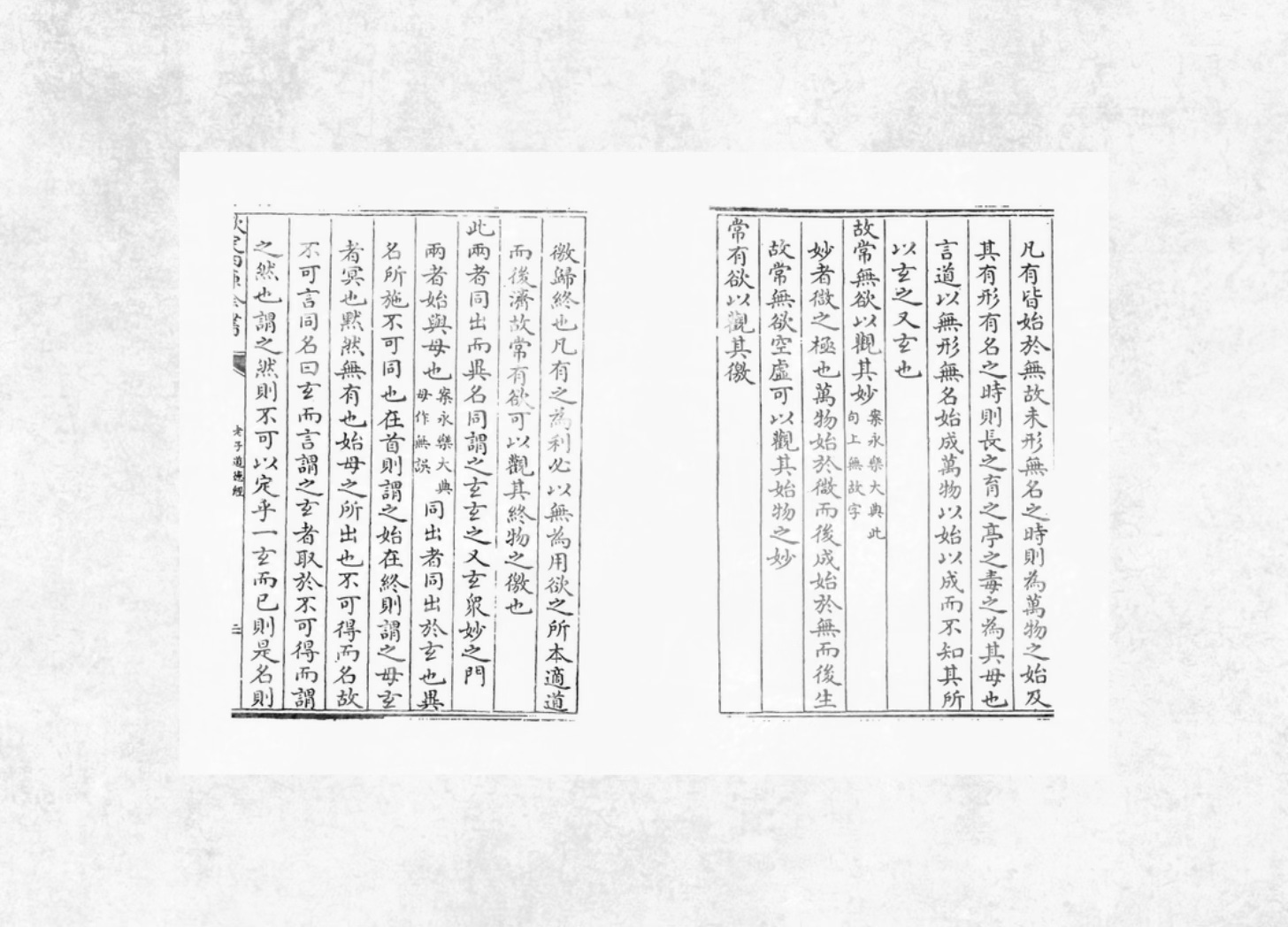
The first chapter of the Tao Te Ching states:
The nameless was the beginning of heaven and earth;
The named was the mother of the myriad creatures.3
The nameless, or what cannot be named, in Lao Tzu’s conception, is the beginning of heaven and earth.
Wang Bi’s comment makes the relationship between being and non-being clear:
All that exists arises from non-being. Therefore, before there were forms and names, it was the beginning of all the myriad things.4
In other words, the myriad things rely on the wu for their existence. Through his interpretation, Wang Bi makes the structure within the original text clear to follow.
In chapter 40 of the text, Lao Tzu further states:
The myriad things arise from being 天下萬物生於有,
and being comes from non-being 有生於無.5
In this sense, wu also indicates the unfathomable, limitless potential and process of creation in multiplying the myriad things. Here, Lao Tzu does not explicitly state that wu can be defined as something not being there at the cosmological level.
That is to say, with A, we can infer, investigate, and pinpoint how and where it originates, perhaps designated as B. As we inquire further about B, we may ask where B is derived.
In this sense, tracing a determinate thing back through its sources and causes leads not necessarily to another fixed entity, but to the open condition that necessitates the emergence of entities. This open condition is what Wang Bi refers to as wu.
Therefore, we can infer that Lao Tzu’s reference to wu indicates a cosmological state of creation: the myriad things, as forms of being, are born from the source of non-being.
Since Tao is also the fountainhead of the myriad things,6 it can be redefined as wu, although Lao Tzu did not make such a claim.
Wu as the embodiment of Tao
In Wang Bi’s system, non-being is identified with Tao, and it represents the ground of all things in the realm of being:
Tao is a name for wu (non-being). There is nothing it does not penetrate, and nothing that does not pass through it. This is why it is called Tao. Silent and still, without a form (ji ran wu ti 寂然無體), it cannot be made into an image.7
The essence of Tao, thus, lies in its qualities of being invisible, ungraspable, yet silent and empowering, quiescent and moving. It seems to be an independent entity, yet immanent in the myriad things in the realm of being.
Based on Lao Tzu and Wang Bi’s writings, we can reach this understanding of Tao. It is full of ontological mystery as the basis for the myriad beings. At the same time, since the Tao (wu) is all-inclusive, in the sense that all the relative distinctions in the realm of being, such as good and evil, right and wrong, are all dissolved, it can be said that it is impartial or amoral, at the axiological level.
Wang Bi does not limit the metaphysics of wu to understanding alone, but also extends it to experiential practices.
Thus, to embrace the Tao, or non-being, one is actually modeling after its characteristics. In Wang Bi’s words:
The Tao, by being formless and non-active (wu-wei), brings to completion the myriad things. Therefore, one who engages with Tao takes wu-wei as a model and silence as instruction. Subtle and continuous, through it, things attain their authenticity. Embracing the Tao this way, as the text says, is to be one with Tao.8
Here, Wang Bi points out the movement of the Tao as wu-wei (non-active), as we can infer that to be active and intentional runs the risk of falling into fixations. And fixations, as the result of subjective actions, can only capture a part of the holistic view.
In commenting on Lao Tzu’s ideal-type of Taoist, in terms of managing social and political affairs, Wang Bi states:
…the heart-mind is not fixed (xin wu suo zhu 心無所主), it becomes one with the whole, with an open awareness having no particular inclinations or aversions.9
This practice of seeing through the limitations of perception is exactly the act of returning to wu. Thus, we can derive two insights from Wang Bi’s non-being as practices:
Rising above fixations, preconceived notions, and partial views (the limitations of being)
Seeing through and overcoming emotions by returning to stillness (the tranquil state of wu) and understanding the nature of things (more in Chuang Tzu’s system)
We cannot forget the historical background of Wang Bi’s writings. During 240 and 249, the Wei dynasty was undergoing a series of political changes, amid intense pressure and anxiety in the intellectual circles and society.
If we perceive philosophy as an inner quest amid an external, changing environment to extract clarity and order from external circumstances, then Wang Bi’s application of wu as a philosophy of life certainly serves as a compass for navigating uncertainties.
In commenting on the hexagram Tai 泰, Wang Bi said:
When heaven and earth are about to close, when the level road begins to tilt, when an age stands on the brink of great change, to remain without losing one’s proper ground in stillness (or dwelling properly 居不失其正), without missing to respond in action, to endure hardship yet remain steadfast, to suffer strain yet not abandon what is right, this is how to be without blame.10
Change always comes, for better or for worse, just like the rotation of the yin and the yang, the silent workings of the Tao. The adjustment of the mind, instead of contending against circumstances and being captured by the limits of the ego, brings back clarity and inner stability.
And from Wang Bi’s perspective, if we can overcome the limitations imposed on us by the realm of being, we are practicing an existential reorientation to return to non-being and then reshape our course in life.
This is part of an ongoing mini-series on Wei-Jin Metaphysics (weijin xuanxue 魏晉玄學) where I write about three representative philosophers of the Wei-Jin period: Wang Bi 王弼, Guo Xiang 郭象, and Ji Kang 嵇康.
Part 3 will be focused on Wang Bi’s conception of non-being as a guiding principle for life.

The historical account of Wang Bi and He Yang and their works is recorded in the Jinshu 晉書. See Yü Ying-shih, “Individualism and the Neo-Daoist Movement in Wei-Jin China,” in Chinese History and Culture: Sixth Century B.C.E. to Seventeenth Century, ed. Josephine Chiu-Duke and Michael Duke (New York: Columbia University Press, 2016), 148-149.
Thomé H. Fang, Chinese Philosophy: Its Spirit and Its Development (Taipei: Linking Publishing, 1981), 157–59.
In fact, another critical Taoist idea, xu 虛, is also generally translated as emptiness or vacuity. But in Lao Tzu and Chuang Tzu’s thinking, xu represents a state of utmost silence and quietude, a cultivated sensibility.
During the Wei-Jin period, Buddhism, still in its early stage of development in China, was able to take root under the influence of Chinese thought, while the neo-Taoist movement — represented by the interpretations of the Tao Te Ching and the I Ching by Wang Bi and the Chuang Tzu by Guo Xiang — was dominating the intellectual sphere. For a detailed investigation of the introduction and evolution of Buddhism since the mid to late Han period, see Tang Yongtong ’s A History of Buddhism during the Han, Wei, Jin, and Northern and Southern Dynasties 漢魏兩晉南北朝佛教史, in particular chapters 4 to 6.
D. C. Lau, trans., Tao Te Ching (London: Penguin Books, 1963), 5.
Wang Bi, et al., Four Kinds of Laotse 老子四種 (Taipei: National Taiwan University Press, 2016), 1.
Richard John Lynn, trans., The Classic of the Way and Virtue: A New Translation of the Tao-te Ching of Laozi as Interpreted by Wang Bi (New York: Columbia University Press, 1999), 1.
Wang Bi, et al., Four Kinds of Laotse, 35.
”The myriad creatures in the world are born from Something, and Something from Nothing.”
D. C. Lau, 47.
Chapter 42 of the Tao Te Ching states: “The way begets one; one begets two; two begets three; three begets the myriad creatures (道生一 一生二 二生三 三生萬物.” D. C. Lau, 49.
Tang Yongtong, Wei-Jin Xuanxue Lungao 魏晉玄學論稿 (Shanghai: Shanghai Century Publishing Group, 2005), 126.
Wang Bi, et al., Four Kinds of Laotse, 20.
Richard John Lynn, The Classic of the Way and Virtue, 91.
Four Kinds of Laotse, 43.
The Classic of the Way and Virtue, 145.
Wang Bi, Han Kangbo, and Zhu Xi, Zhouyi erzhong 周易二種 (Two Commentaries on the Book of Changes/Zhou Yi) (Taipei: National Taiwan University Press, 2016), 40.
Thank you for this well-explained overview of Wang Bi's thoughts.
excellent analysis of 无 - i always find it to be one of more interesting aspects of daoist thought. i figure 无 is the initial state, almost like a young mind, free of knowledge but with a hidden base set of proclivities.