

Walks, Meditations, and Silence
Part 4: Wang Wei's Ch'an poems and the freedom of not-dwelling

Have you ever felt stuck somewhere in life?
You are somehow trapped in a situation where the way out is hidden from sight. No matter how hard you try to break free, life simply seems to stagnate.
Your spirit feels pinned to the ground by something unspeakably heavy, and it persists.
Every day, life becomes more dreadful because you know this is not the place you wanted to be.
With each failed attempt to change your situation, you become enclosed by thickening anxiety, self-consciousness, self-doubt, and indecision.
At this point, the reconstructed perception of your reality, filtered through emotion, transmitted by forces of conditioning, has already begun to shape how you operate, perhaps often without your noticing.
In the Buddhist view, this is the self being dictated by the five skandhas (yun 蘊): forms, feelings, perceptions, impulses, and consciousness.
The senses of the self interact endlessly with external causes and conditions, the flux of circumstances.
Yet even these “causes and conditions,” artificially constructed, are also subject to change. They are transitory, unreliable, and inescapably empty.
Liberation arises from seeing through the dependent nature of this situation, while resting one’s awareness in the present moment, allowing the heart-mind to dwell in a state of stillness.
The challenge, though, is that we are everywhere entangled with the phenomenal world.
Am I being operated by my emotions, my ego, my limited perception of reality, instead of seeing it as it actually is?
Am I aware of being aware?
Chuang Tzu once asked something similar, casting doubt on the idea of “certainty,” or the fixation on it:1
Those who dream of drinking wine lament when the morning arrives.
(meng yinjiu zhe dan er kuqi 夢飲酒者 旦而哭泣)
Those who dream of weeping go out hunting when morning comes.
(meng kuqi zhe dan er tianlie 夢哭泣者 旦而田獵)
Perhaps with more life experiences, I can come to terms with the reality I find myself in while still thinking about the time when I dreamt something different, more delicious, joyful.
But what is time? Is it not the case that, when deemed in the infinite realm of evolutionary space, or the boundless sphere of the Tao, our lifetime is perhaps just a passing of a few seconds?
On another occasion, I may revel in some desirable encounters in life while overwhelmed by the sorrowful moments of the past, with the buried memories like a current gushing out.
But what is real? Who am I? Can we free ourselves from the concrete circumstances we find ourselves in?
Wang Wei, in his Ch’an poems, usually does not answer these questions directly. He just shows us what it looks like when we stop asking them in the way we are accustomed to.
Not knowing, yet at ease
A shared lesson between Taoism and Buddhism is that sometimes the first step toward liberating the spirit lies not in seeking direct answers, but in releasing the need to do so.
The reason such intentional effort may not work is that one could be striving to bend reality to one’s liking and preferences, while overlooking the fluid nature of external reality, like trying to catch flowing water with one’s hand.
Wang Wei knew this when he wrote about visiting a temple:2
I do not know the Temple of Gathered Fragrance, 不知香積寺
For several miles, entering cloudy peaks. 數里入雲峰
Ancient trees, paths without people; 古木無人徑
Deep in the mountains, where is the bell? 深山何處鐘
Noise from the spring swallows up lofty rocks; 泉聲咽危石
The color of the sun chills green pines. 日色冷青松
Toward dusk by the curve of an empty pond, 薄暮空潭曲
Peaceful meditation controls poison dragons. 安禪制毒龍
The poem opens with not knowing. He simply wanders through the mountain trails. Perhaps the journey of several miles is also illusory because there is no assurance of a destination.
In our ordinary lives, not knowing where we are going creates the condition for anxiety. We habitually want a map, some measurable milestones, and proof that we are walking on the right path. But what is “right”? Or more importantly, is there a path to cling to?
Wang Wei offered no answer. The ancient trees did not build paths for people. And the deep mountains could not direct the poet toward the source of the ringing bell.
And yet we do not detect distress in the poem. Along with the poet, we seem to hear the sound of a spring welling up from nowhere, swallowing and etching the boulders in its silent, steady, and mysteriously powerful way.
The not-knowing is simply there, accepted without resistance. Wang Wei ended the poem with a sitting meditation, resting the mind-space in a state of quietude and stilling awareness.
A similar, more evident quality appears in his tribute to Mt. Zhongnan:3
Taiyi (Mt. Zhongnan) nears the celestial capital; 太乙近天都
Continuous mountains arrive at the edge of the sea. 連山到海隅
White clouds, as I turn and gaze, merge. 白雲迴望合
Azure mists, as I enter and look, disappear. 青靄入看無
The whole expanse shifts at the central peak. 分野中峰變
Shadow and light differ in every valley. 陰晴眾壑殊
Wishing to seek lodging among men, 欲投人處宿
I cross the water to ask an old woodsman. 隔水問樵夫
Here, the clouds that seemed solidly separate, once you look back, simply embraced and closed together. And the mist that seemed present, once you walk into it, suddenly vanishes.
Nothing holds still long enough to be grasped. And direction and distance shift with each step.
The poem ends not with insight or conclusion, but with a spontaneous move — the thought of asking a woodcutter where one might spend the night. But perhaps while wandering in the vastness of the field, the poet may realize that the “ask” is really unnecessary.
This simple psychological ease is gradually earned through experiencing and understanding that it does not depend on knowing. It is found in a heart-mind that has stopped looking for certainty.
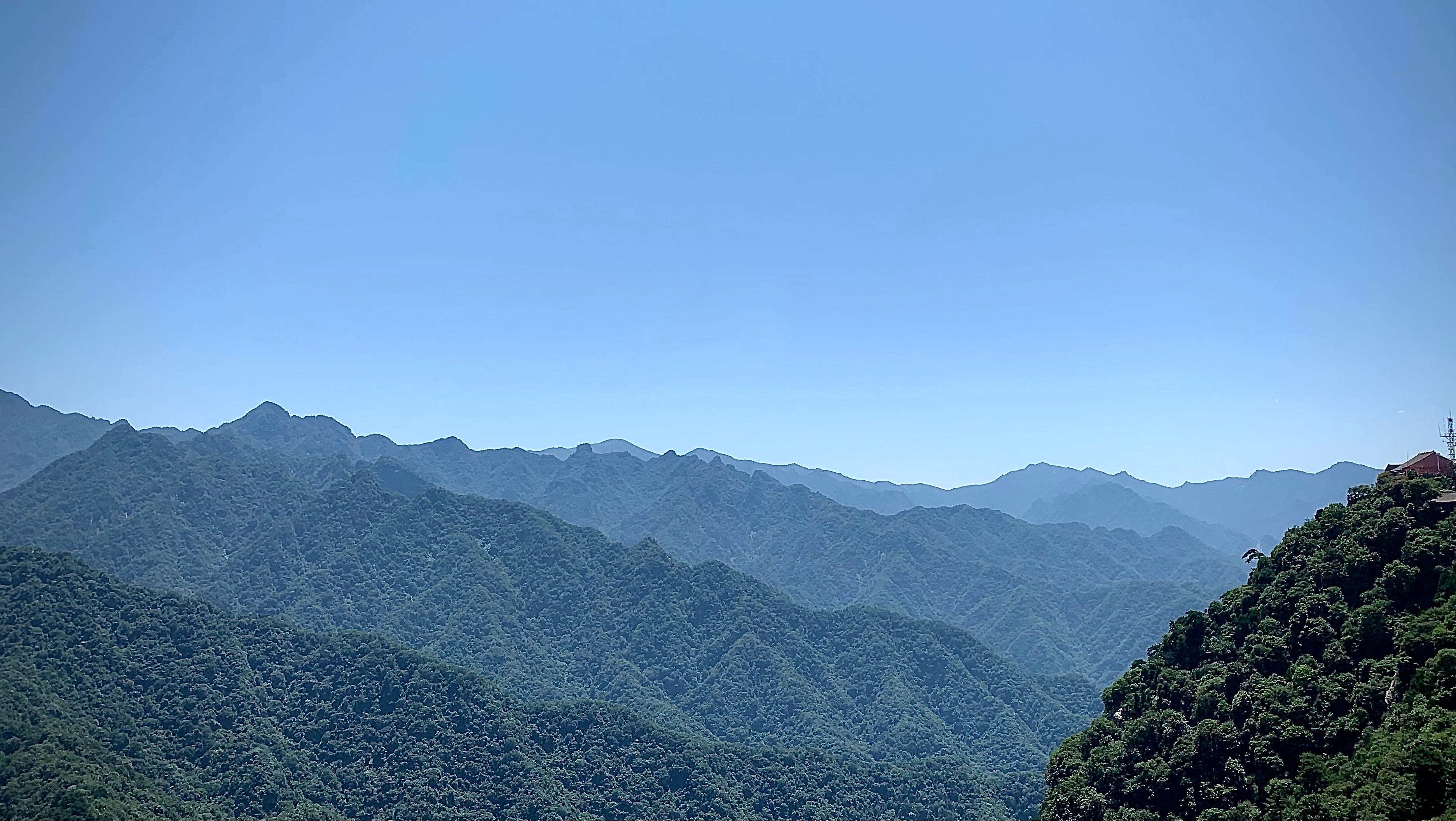
The practice of not-dwelling
There may come a moment in life when you feel you need some time to just be with yourself.
Not that you want to escape from the usual, routine life. Not to avoid interactions with the crowd.
Such a moment arises when you realize that you’ve grown tired of the persona that you have been living in for years. You temporarily withdraw from everything familiar because you have captured a glimpse of who you really are, and you want to spend more time getting to know that person.
Solitude creates such a space for inward orientation.
Wang Wei knew this. After fulfilling his worldly duties, he went into the mountains. This was his ritual of return, the practice of rediscovering himself. In such casual, unplanned sauntering, he found the poetic lines that speak his inner voice:4
Zhongnan Retreat 終南別業
In middle years I am rather fond of the Tao; 中歲頗好道
My late home is at the foot of Southern Mountain. 晚家南山陲
When the feeling comes, each time I go there alone. 興來每獨往
That splendid things are empty, of course, I know. 勝事空自知
I walk to the place where the water ends 行到水窮處
And sit and watch the time when clouds rise. 坐看雲起時
Meeting by chance an old man of the forest, 偶然值林叟
I chat and laugh without a date to return. 談笑無還期
He walks, pauses, reflects, perhaps following along with a flowing stream. On a summer afternoon after the rain, the forest seems to become greener. And when the path runs out, he simply sits down.
There is no frustration, no worry, and no resistance. With a simple tuning of the state of mind, the poet could direct his attention to the rising clouds.
This is the practice of non-dwelling. The mind does not fix itself on where the path was supposed to lead. It is not consumed by the disappointment that the water has ended. And naturally, it just turns toward whatever arises next.
In other words, the heart-mind is restored to a state of lucidity and clear awareness, emptied from emotions, fixations, desires, and reactions arising from interaction with the external environment.
This spontaneous awareness allows the poet to truly observe the “splendid things”, as well as those unpleasant things that cause pain and suffering, seeing into the empty nature of them, and hence, let them dissolve.
The experience of Ch’an 禪 (Zen), in a moment of silent meditation, allows one to see the distinction between subject and object fused, with the self vanishing.
The state of equanimity arises not from having victories over circumstances, or having goals achieved, but in seeing all these things—the losses, dead ends, failures, and the next glorious thing—as continuous. Just like treating gain and loss, formation and destruction, or even life and death as essentially the same phase of the constant impermanence in the dharma world, or the unity of things in the infinite realm of Tao.
The ten thousand years are the same in the eyes of the sky.
And the pine wind, the bright moon, and the flowing river embody the beauty of eternity and transitoriness at the same time.
What we realize from such a way of seeing is that, surprisingly, the end of a path is never the only thing happening there. Something is always rising, just beyond what we are looking at.
Your circumstances are not rigid and definitive. They are always fluid, changing, moving, and becoming.
We can see it, whatever unfolds, as long as we are not closed within.
—
And yet, I don’t think Wang Wei wants us to mistake this ease for an escape — a clever trick of attention that simply redirects us away from pain in the midst of concrete living. There is something further than that:5
Being and nonbeing, we cease to see as before; 有無斷常見
Life and death—we receive them all as a dream. 生滅幻夢受
Falling ill you approach your true form, 即病即實相
Follow emptiness, and calm violent motion. 趨空定狂走
There is no single dharma that is real; 無有一法真
There is no single dharma that is impure. 無有一法垢
It’s not that seeing through your suffering will dissolve it into peace. It says something stranger: your suffering, exactly as it is, already is the reality that you were looking for all along.
As the popular line from the Heart Sutra says,
Form is not different from emptiness 色不異空
Emptiness is not different from form. 空不異色
Form is emptiness 色即是空
Emptiness is form. 空即是色
Form, or appearance, one aspect of the myriad things in the phenomenal world, is inevitably fluid and empty. Likewise, feelings and perceptions are also conditional and temporary. They arise and fall in given conditions, byproducts of your entanglements in the things and events around you, dwelling in the vessel that receives them, namely, you.
So the quiescence and silence found through emptiness and the myriad entanglements is the crystallization of what is real.
You simply let the distress, disturbance, and anguish pass through you; this is the key to spiritual growth and to developing that inner spaciousness that will sustain you in the journey of life.
With this understanding, we come to the position that awareness precedes the thinking, distinguishing mind as it begins to work.
That is to say, the feeling of being stuck and the urge to transcend it are all illusions, as these feelings are attached to something transitory, inconstant.
At some point in life, you finally learn to stop adding the second layer — the panic about being stuck, the story about what it means, the urgent search for an exit that itself becomes another kind of trap.
The ending is never the obstacle.
The obstacle is the fixation on it being something other than what it actually is.
Previous posts on Wang Wei:


From the second chapter of the Chuang Tzu text, “Qi Wu Lun 齊物論,” roughly translated as “Equalizing Things.”
The title of this poem is “Visiting the Temple of Gathered Fragrance 過香積寺.” The temple belongs to the Pure Land School (jingtuzong 淨土宗) and still operates in Xi’an today.
Pauline Yu, The Poetry of Wang Wei (Bloomington: Indiana University Press, 1980), 145.
Ibid., 170. The title of this poem is “Mt. Zhongnan 終南山.”
Ibid., 171.
Ibid., 132. This very Buddhist poem is titled “Kulapati Hu Lay Ill in Bed, so I Sent Some Grain and Presented This Poem to Him 胡居士臥病遺米因贈.”
Yuxuan, Finding this inspiring as I start my weekend. There's really no answer as you said to me before. But perhaps freedom can also be found in our constraints, in the re-reading, to look deeply again into this multi-dimensionality of life.
Some of my favorite lines from this post: "The ancient trees did not build paths for people. And the deep mountains could not direct the poet toward the source of the ringing bell... The ten thousand years are the same in the eyes of the sky. And the pine wind, the bright moon, and the flowing river embody the beauty of eternity and transitoriness at the same time."
relate to Neuro studies and stimulants- not even necessarily substance as stimulants but physical activity itself in the production of increased blood flow- oxygenation of the blood and in turn the brain that increases cognitive functions and increased mental awareness and conceptualization.
I often power walk, almost a jogging pace 5-8 miles sometimes, then 5-8 miles back. I find I actually do my best thinking on these walks.